
Discover how AI-powered recruitment is changing hiring through automation, faster screening and better talent matching while addressing bias, privacy and human oversight.
First answer me “Would you trust AI to decide whether you get your next job?”
1. Introduction: Is Artificial Intelligence Changing the Way We Hire?
Imagine applying for a job and receiving a response within minutes.
Your resume is scanned automatically. Your skills are matched with the job description. A chatbot answers your questions. An online assessment evaluates your abilities. A recruiter then reviews the most suitable candidates.
This may sound like something from the future, but it is already becoming part of modern recruitment.
Artificial Intelligence (AI) is changing the way organizations find, screen, evaluate, and communicate with job candidates.
For employers, the attraction is easy to understand. Recruitment can be time-consuming. A single job opening may attract hundreds or even thousands of applications. Recruiters have to read resumes, communicate with candidates, schedule interviews, compare qualifications, and maintain records.
AI can automate many of these repetitive activities.
But there is another side to the story.
When an algorithm helps decide who gets an interview, the consequences can be significant. A poorly designed system may overlook a talented candidate. Biased training data may produce unfair recommendations. Candidates may not know that AI is evaluating them. Personal information may also be processed on a large scale.
So the real question is not simply:
“Can AI recruit people?”
The more important question is:
“How can organizations use AI to make recruitment faster and better without losing fairness, transparency, and the human touch?”
That is where the future of AI-powered recruitment becomes interesting.
2. What Is AI-Powered Recruitment?
AI-powered recruitment means using artificial intelligence and related technologies to support different stages of the hiring process.
These technologies can help organizations:
- Find potential candidates
- Screen resumes
- Match skills with job requirements
- Communicate with applicants
- Schedule interviews
- Conduct assessments
- Analyze recruitment data
- Support recruiters in decision-making
AI does not necessarily mean that a machine makes the final hiring decision.
In a well-designed recruitment process, AI can work as an assistant to recruiters, helping them manage large amounts of information while humans remain responsible for important decisions.
This distinction is important. The goal should not be:
Human recruiters vs. AI
It should be:
Human recruiters + AI
3. Why Are Companies Turning to AI for Recruitment?
Recruitment has become more complex.
Organizations are competing for skilled employees while candidates have access to more information about employers and job opportunities than ever before.
At the same time, recruiters may receive huge numbers of applications for a single position.
AI can help organizations manage this complexity.
The World Economic Forum’s Future of Jobs Report 2025 projects major labour-market transformation by 2030, with 170 million jobs potentially created and 92 million displaced, resulting in a net increase of 78 million jobs. The report also highlights rapid changes in the skills employers need.
This changing employment environment makes effective talent identification increasingly important.
4. How AI Is Used in Recruitment
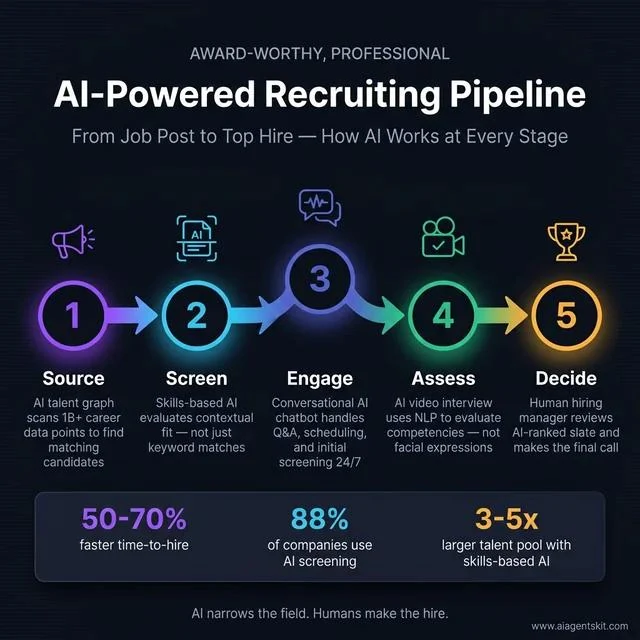
AI can be used at several stages of the recruitment journey.
4.1. Writing Job Descriptions
Recruiters can use AI tools to create clearer job descriptions. For example, AI can help:
- Structure job advertisements
- Identify missing skills
- Improve readability
- Suggest inclusive language
- Create different versions for different platforms
However, recruiters should review AI-generated job descriptions carefully. An AI tool does not automatically understand the organization’s culture, legal requirements, or real expectations for a particular role.
4.2. Finding Candidates
AI can help identify potential candidates from:
- Online job portals
- Professional networks
- Internal talent databases
- Previous applicants
- Recruitment platforms
Instead of manually searching through thousands of profiles, recruiters can use AI-supported systems to identify candidates whose skills appear relevant to a particular position. This can save considerable time.
4.3. Resume Screening
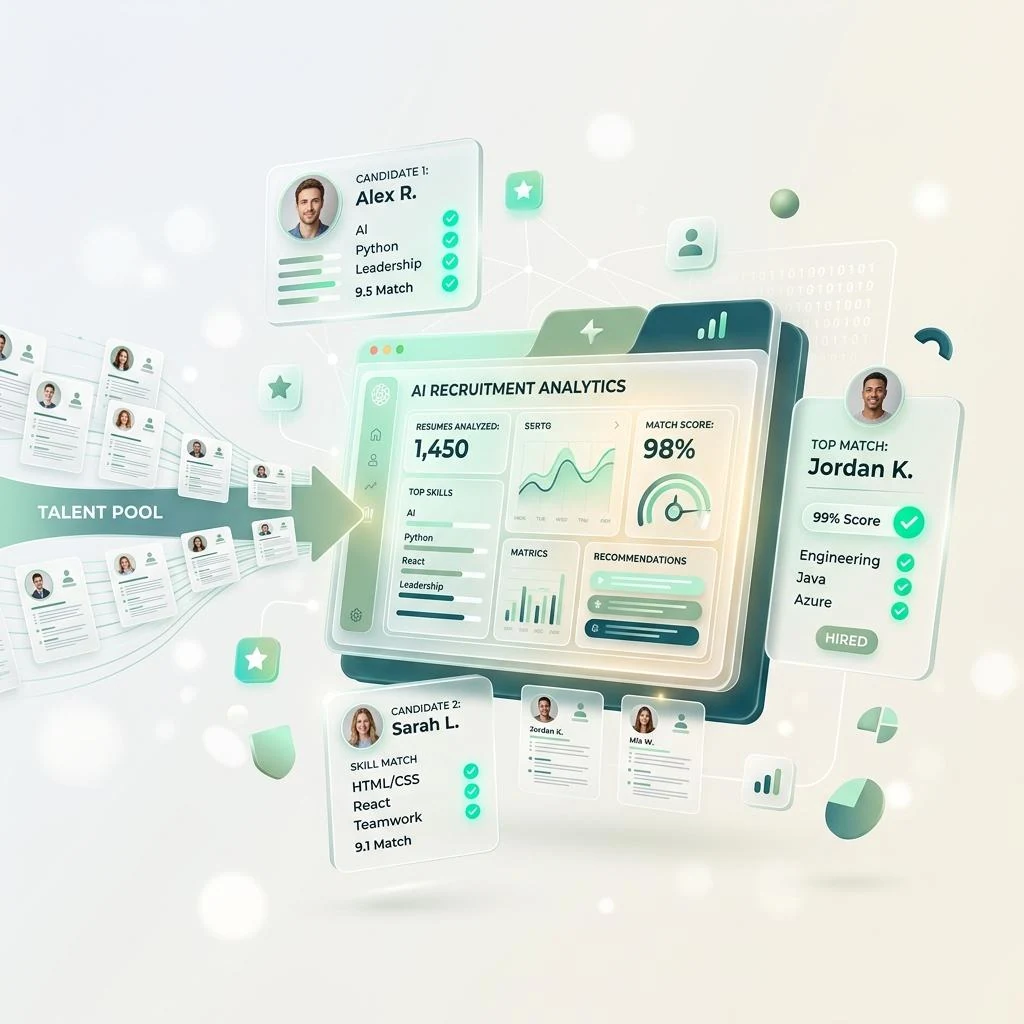
Resume screening is one of the most common applications of recruitment technology. An AI system can examine resumes and identify information such as:
- Education
- Work experience
- Technical skills
- Certifications
- Job titles
- Relevant keywords
The system can then help rank or group candidates for further review. However, keyword matching has an important limitation. A highly qualified candidate may use different terminology from the wording used in the job description.
For example, a candidate might write “customer relationship management”, while the job description uses “CRM.”
A sophisticated system may recognize the connection, but a simple keyword-based system might not. That is why AI screening should not become an unquestioned gatekeeper.
4.4. Candidate Matching
AI can go beyond keywords by comparing candidate skills with job requirements.
For example: Job requirement: Digital Marketing Manager
The system may look for experience in:
- Search engine optimization
- Social media marketing
- Performance marketing
- Marketing analytics
- Content strategy
- Customer acquisition
It may then identify candidates with similar skill profiles even when their resumes use different wording. This can help recruiters discover candidates who might otherwise be overlooked.
4.5. Chatbots for Candidate Communication
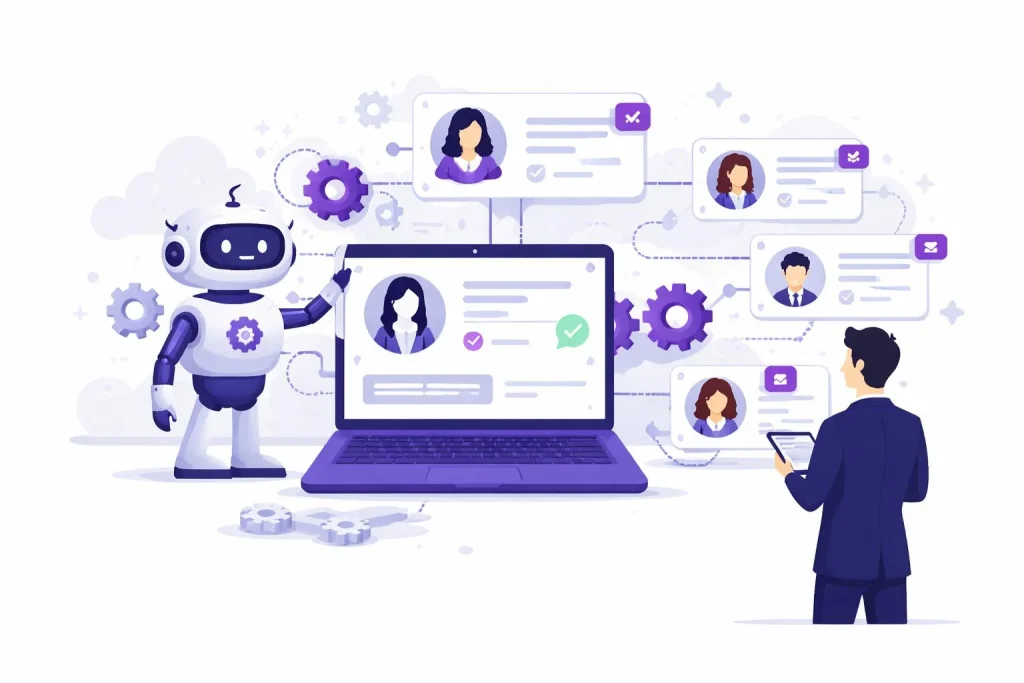
Recruitment chatbots can answer common questions from applicants.
Candidates may ask:
- What are the eligibility requirements?
- When is the application deadline?
- What documents are required?
- What is the interview process?
- Is the position remote or hybrid?
Instead of waiting for a recruiter to respond, candidates can receive immediate answers. This can improve the overall candidate experience.
4.6. Interview Scheduling
Scheduling interviews sounds simple, but it can consume significant administrative time. AI-powered systems can coordinate:
- Candidate availability
- Recruiter availability
- Interview panels
- Time zones
- Meeting links
- Reminders
This allows HR teams to spend more time on meaningful interactions with candidates.
4.7. Assessing Candidates
AI can support online assessments involving:
- Technical knowledge
- Cognitive skills
- Job-related competencies
- Problem-solving
- Language skills
Some systems may also analyze responses or patterns in assessment performance. However, assessment tools should be carefully validated.
A test should measure something genuinely relevant to the job rather than simply measuring how comfortable a candidate is with a particular technology.
4.8. Supporting Interview Processes
AI can also assist recruiters during interviews by:
- Generating interview questions
- Creating interview summaries
- Organizing candidate notes
- Comparing responses against predefined criteria
- Identifying areas requiring follow-up
However, automated interpretation of facial expressions, voice patterns, or personality from video interviews deserves particular caution. Human behaviour is complex, and technology should not be treated as an infallible judge of personality or potential.
5. Major Benefits of AI-Powered Recruitment
5.1. Faster Hiring
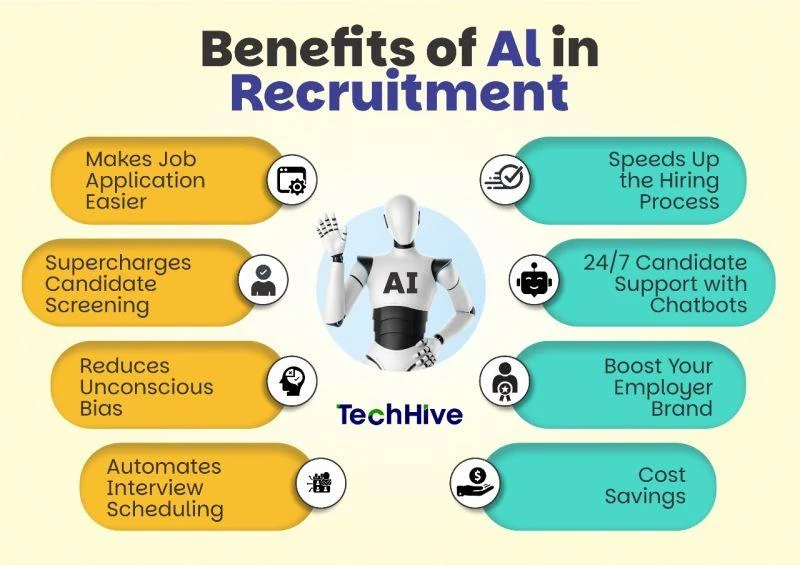
One of the biggest dvantages of AI is speed. Tasks that might take hours can sometimes be completed much faster with automation. For organizations hiring at scale, this can make a significant difference.
5.2. Reduced Administrative Work
Recruiters often spend considerable time on repetitive tasks. AI can help automate:
- Resume sorting
- Interview scheduling
- Candidate notifications
- Data entry
- Recruitment reports
This allows HR professionals to focus more on people rather than paperwork.
5.3. Better Candidate Matching
AI can identify relationships between skills, experience, and job requirements. This may help organizations identify candidates based on capabilities rather than relying solely on traditional resume formats.
5.4. Improved Candidate Experience
Fast communication matters. Candidates do not want to submit an application and hear nothing for weeks. Automated communication can provide:
- Application confirmation
- Status updates
- Interview reminders
- Frequently requested information
Even when a candidate is unsuccessful, clear communication can improve their perception of the organization.
5.5. Support for Recruiters
AI does not have to replace recruiters. Instead, it can help them handle large amounts of information. Think of AI as a co-pilot for recruitment. The recruiter remains responsible for judgment, empathy, context, and final decisions.
5.6. Recruitment Analytics
AI can help HR teams understand recruitment data. For example, organizations can examine:
- Time to hire
- Source of candidates
- Application conversion rates
- Interview-to-selection ratios
- Recruitment costs
- Candidate drop-off rates
These insights can help organizations improve their recruitment strategies.
6. Can AI Make Recruitment More Fair?
This is one of the most interesting questions. Human recruiters can have conscious or unconscious biases. AI is sometimes presented as a solution because machines do not have human emotions. But there is a problem:
AI learns from data, and data can contain human bias.
If historical hiring decisions favored a particular type of candidate, an AI system trained on that history may learn the same pattern.
For example, suppose a company historically hired more people from a particular educational background. An AI system might conclude that this background is associated with successful employees. It could then give similar candidates higher scores. The problem is that historical success does not necessarily mean the historical hiring process was fair.
7. The Risk of Algorithmic Bias
Bias can enter an AI recruitment system through:
- Training data
- Historical hiring decisions
- Poorly selected variables
- Incomplete datasets
- Biased job descriptions
- Proxy variables
- Human assumptions built into the system
The U.S. Equal Employment Opportunity Commission has specifically warned that AI and automated systems used in recruitment and hiring can create discrimination risks. Existing employment discrimination protections still apply when AI is involved. This is an important lesson for organizations:
Using AI does not remove legal or ethical responsibility.
8. Privacy: Another Major Concern
Recruitment involves personal information.
A candidate may provide:
- Name
- Address
- Phone number
- Educational qualifications
- Employment history
- Salary expectations
- Assessment results
Some recruitment systems may process additional information. Organizations therefore need to think carefully about:
What data are we collecting?
Why are we collecting it?
Who can access it?
How long will we keep it?
How will it be protected?
Candidates should not be expected to give up privacy simply because an organization uses advanced technology.
- The Transparency Problem
Imagine receiving an email saying:
“Your application was not selected.”
- But you have no idea why.
- Was your experience insufficient?
- Was your resume rejected by an automated system?
- Did the AI misunderstand your skills?
- Was the position already filled?
Lack of transparency can create frustration and mistrust. Organizations should therefore provide reasonable information about how AI is being used in recruitment, particularly when automated tools significantly influence decisions.
10. The Human Touch Still Matters
Recruitment is ultimately about people. A resume cannot tell the complete story of a candidate. Consider two applicants:
Candidate A
- Excellent academic record
- Strong technical skills
- Limited practical experience
Candidate B
- Average academic record
- Strong practical experience
- Excellent communication
- Strong problem-solving ability
Which candidate is better?
There may not be a simple answer. The best choice depends on:
- Job requirements
- Team environment
- Organizational culture
- Candidate potential
- Learning ability
- Leadership expectations
Human recruiters can consider context in ways that automated systems may struggle to capture.
11. AI Recruitment vs. Traditional Recruitment
|
Area |
Traditional |
AI-Powered Recruitment |
|
Resume screening |
Mostly manual |
Automated or AI-assisted |
|
Candidate communication |
Human-led |
Human + chatbot |
|
Scheduling |
Manual coordination |
Automated scheduling |
|
Data analysis |
Time-consuming |
Faster analytics |
|
Candidate matching |
Recruiter judgment |
AI-assisted matching |
|
Scalability |
Limited |
High |
|
Human interaction |
High |
Can vary |
|
Bias risk |
Human bias |
Data + algorithmic bias |
|
Transparency |
Usually easier to explain |
May be difficult with complex models |
|
Decision-making |
Primarily human |
Should ideally remain human-led |
The table shows that AI does not automatically make recruitment better. It changes the process. The quality of the result depends on how the technology is designed, implemented, monitored, and combined with human judgment.
12. What Should Organizations Do?
Responsible AI recruitment requires more than purchasing an AI software package. Organizations should establish clear practices.
12.1. Start With the Job, Not the Algorithm
First define:
- What does the job actually require?
- Which skills matter?
- Which qualifications are essential?
- Which characteristics are irrelevant?
Only then should an AI system be configured.
12.2. Test for Bias
Organizations should regularly examine whether the system produces significantly different outcomes for different groups. Testing should not happen only once. AI systems need continuous monitoring.
12.3. Keep Humans in the Loop
Important hiring decisions should receive appropriate human review. AI should provide recommendations—not unquestionable answers.
12.4. Explain the Process
Candidates should know when AI is being used in recruitment, particularly when it has a meaningful role in assessment or selection.
12.5. Protect Candidate Data
Recruitment systems should have strong security and clear data-handling practices.
12.6. Provide a Way to Ask Questions
Candidates should have an appropriate channel to seek clarification or request human
assistance when necessary.
12.7. Evaluate the AI System Regularly
A recruitment system that performed well two years ago may not perform equally well today.
Job requirements change.
Candidate pools change.
Technology changes.
Therefore, AI recruitment systems should be reviewed regularly.
- A Useful Framework for Responsible AI Recruitment
Organizations can think about AI recruitment through six simple principles:
F — Fairness: Does the system treat candidates fairly?
T — Transparency: Can candidates and recruiters understand how it is being used?
A — Accountability: Who is responsible for the outcome?
P — Privacy: Is candidate information protected?
H — Human Oversight: Can humans review important decisions?
E — Evaluation: Is the system regularly tested and improved?
Together, these principles create a simple F-T-A-P-H-E framework for responsible AI recruitment. The exact governance process should be adapted to the organization’s industry, location, legal obligations, and level of AI use.
- What the NIST AI Framework Can Teach HR Teams
Organizations looking for a structured approach to managing AI risks can also explore the NIST AI Risk Management Framework. NIST’s framework emphasizes trustworthy AI characteristics such as validity, reliability, safety, security, accountability, transparency, explainability, privacy, and fairness. It organizes risk management around four functions: Govern, Map, Measure, and Manage.
Although the framework is not specifically a recruitment manual, its principles can provide a useful foundation for organizations using AI in hiring.
15. What Does AI Recruitment Mean for Students and Job Seekers?
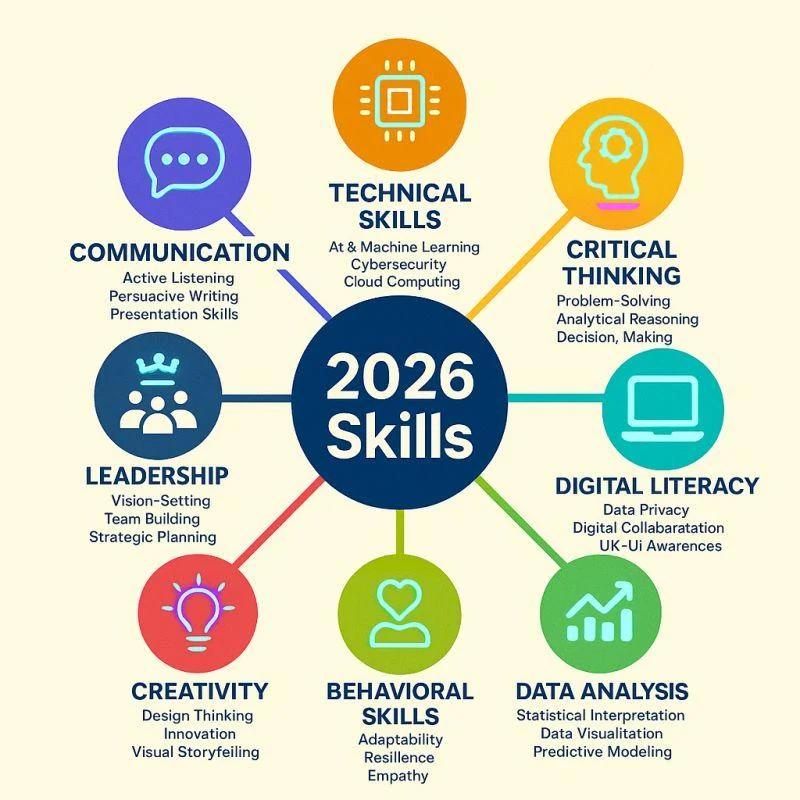
AI is changing the recruitment process, but it is also changing what employers look for. Students should not focus only on making a resume that passes an automated screening system. They should build genuine skills.
Important areas include:
- Communication
- Problem-solving
- Digital literacy
- AI literacy
- Critical thinking
- Creativity Adaptability
- Teamwork
- Domain knowledge
The World Economic Forum continues to emphasize the importance of both technology skills and human capabilities as the labour market changes.
For students, the message is simple:
Do not prepare only topass the AI screening system. Prepare to succeed after you get the job.
- How Job Seekers Can Prepare for AI-Assisted Recruitment
Candidates can take several practical steps.
- Use Clear Resume Language: Describe skills and achievements clearly.
- Highlight Relevant Skills: Connect your skills directly to the requirements of the position.
- Show Results: Instead of writing:
“Worked on marketing campaigns.”
Consider:
“Supported digital campaigns that increased website enquiries.”
Specific evidence is easier for both humans and systems to understand.
4. Keep Your Resume Honest: Do not add skills simply because a job description mentions them. AI may help you get noticed, but interviews and actual work will reveal whether the skills are genuine.
5. Develop Human Skills: Communication, empathy, teamwork, creativity, and problem-solving remain important.
- Will AI Replace Recruiters?
Probably not in the simple way people sometimes imagine. AI may automate many recruitment tasks, but recruitment involves more than screening resumes.
Recruiters also:
- Build relationships
- Understand organizational culture
- Communicate difficult decisions
- Assess complex situations
- Negotiate offers
- Support hiring managers
- Create positive candidate experiences
These responsibilities require human judgment.
The likely future is therefore not “AI replaces recruiters.”
It is: “Recruiters who use AI effectively may outperform recruiters who do not.”
This is an important distinction.
- The Future of AI-Powered Recruitment
Recruitment is likely to become increasingly data-driven and personalized.
Future systems may help organizations:
- Identify skills rather than just job titles
- Match candidates with career pathways
- Predict future skill requirements
- Recommend internal candidates for new roles
- Support continuous talent development
- Personalize candidate communication
- Identify skill gaps within organizations
The World Economic Forum’s 2026 discussion of entry-level work also highlights how AI is reshaping how organizations hire, develop, and advance talent, particularly at the beginning of careers.
This means recruitment may gradually move from simply asking:
“Who should we hire?”
to asking:
“What skills do we need, where can we find them, and how can we help people develop them?”
That is a much broader role for HR.
- The Biggest Opportunity: Better Human-AI Collaboration
The greatest opportunity may not be automation itself. It may be collaboration between humans and AI. AI is good at:
- Processing large datasets
- Finding patterns
- Repeating tasks
- Ranking information
- Producing quick summaries
Humans are better positioned to:
- Understand context
- Show empathy
- Make ethical judgments
- Build relationships
- Handle complex conversations
- Consider organizational culture
When these strengths are combined properly, recruitment can become both more efficient and more human. The World Economic Forum has similarly highlighted that responsibly designed AI can potentially improve inclusion and transparency in recruitment, while stressing the need for careful risk management and governance.
A Simple Example
Consider a company receiving 5,000 applications for 100 vacancies. A traditional recruitment team might struggle to review every application carefully.
An AI-supported process could:
Step 1: Collect applications.
Step 2: Identify basic eligibility.
Step 3: Group candidates according to relevant skills.
Step 4: Identify potentially strong candidates.
Step 5: Send selected applications to human recruiters.
Step 6: Recruiters conduct structured interviews.
Step 7: Hiring managers make final decisions.
This model allows technology to handle volume while humans remain responsible for judgment.
That is probably a healthier way to think about AI-powered recruitment.
- AI Recruitment: Opportunity or Threat?
The answer is:
It can be either.
AI becomes an opportunity when it:
- Reduces unnecessary administrative work
- Helps identify suitable talent
- Improves candidate communication
- Supports recruiters
- Provides useful insights
- Encourages skills-based hiring
It becomes a threat when it:
- Discriminates
- Hides decision-making
- Collects excessive personal data
- Rejects qualified candidates unfairly
- Removes meaningful human oversight
- Treats algorithmic recommendations as unquestionable truth
The technology itself is not automatically good or bad. The way organizations design and use it matters.
- Conclusion: The Future of Recruitment Is Human + AI
AI-powered recruitment is changing the hiring landscape. It can make recruitment faster, more scalable, more data-driven, and potentially more consistent. Recruiters can spend less time on repetitive administrative work and more time engaging with candidates and hiring managers.
But AI also introduces serious challenges.
Bias, privacy, transparency, accountability, accessibility, and excessive automation must be taken seriously. A recruitment system can process thousands of applications in seconds, but speed is not the same as fairness.
The best approach is therefore not to choose between humans and machines. It is to combine their strengths.
AI can process the data. Humans can understand the person.
For organizations, the goal should be responsible AI adoption with strong governance and human oversight. For recruiters, the future will require both HR expertise and AI literacy.
For students and job seekers, building genuine skills will remain more important than simply learning how to satisfy an algorithm.
And for society, the central question will remain:
Can we use powerful technology to make hiring not only faster, but also fairer, more transparent, and more human?
The answer will depend less on the technology itself and more on the choices organizations make while using it.
good and realistic topic and worth to share
great information
I am working in a company, and sometimes I find that it happens in real life.
Very informative article! AI is transforming the recruitment process by making hiring faster and more efficient. However, human judgment and fairness should always remain important in final hiring decisions.
Excellent insights into AI-powered recruitment. The discussion about algorithmic bias and data privacy highlights the importance of using AI responsibly in human resource management.
A well-explained article on the future of hiring. I believe the combination of AI technology and human expertise can improve candidate selection and create a better recruitment experience.
Great article! AI can save recruiters valuable time and help identify suitable candidates. Regular monitoring, transparency, and human oversight are essential to ensure fair recruitment practices.
Very useful and thought-provoking content. The future of recruitment is not about replacing humans with AI, but about combining technology with human intelligence to make hiring smarter, fairer, and more effective.