Why We Buy with Emotion and Justify with Logic: The Science Behind Shopping

People buy with feeling, then find logic to defend it. Learn the science behind emotional buying, post-purchase rationalization, and smarter shopping.

we buy with emotion and justify with logic
Emotional purchasing and justify with logic

1. Introduction

Think about the last time you bought something you did not plan to buy. Maybe it was a pair of sneakers. Maybe a phone cover, or a jacket on sale. 

Now remember what you told yourself afterwards. “It was on offer.” “I will use it every day.” “My old one was getting worn out.”

Notice the order. The wanting came first. The reasons showed up later, like lawyers called in to defend a client. 

Psychologists have a simple way to say this: we buy with emotion and justify with logic. This blog explains what that means, what science says about it, and how you can shop with your eyes open. The language is simple, and every term is explained, so you can use it for class notes, projects, or just your own wallet.

2. In Short: The Whole Idea in Three Lines

  • Step 1: A feeling pulls you toward a product (excitement, pride, fear of missing out, a need to belong).
  • Step 2: You decide, often fast and often without noticing how.
  • Step 3: Your mind collects reasons that make the choice look sensible.

That is the pattern. The rest of this blog shows why it happens.

3. Key Terms in Simple Words

TermSimple MeaningExample
Emotional buying decisionA purchase driven mainly by feeling, not by careful comparisonBuying a jacket because it makes you feel confident
System 1Fast, automatic thinking that runs on instinct and feelingGrabbing the snack at the billing counter
System 2Slow, effortful thinking that compares and calculatesComparing three laptops on price and specs
Somatic markerA body signal tied to a past experience that tags an option as good or badA “bad feeling” about a shop that once cheated you
Cognitive dissonanceThe mental discomfort of holding two clashing thoughts“I wanted to save money” and “I just spent ₹3,000 on shoes”
Post-purchase rationalizationFinding good reasons for a purchase after you have made it“These shoes will last for years, so they are worth it”
Buyer’s remorseRegret after buying somethingFeeling uneasy a day after a big online order

4. Do We Really Buy with Emotion First?

Short answer: science says emotion plays a bigger role than most of us think. And it is not just a distraction. It is part of how we decide at all.

5. What Is the Somatic Marker Hypothesis?

The somatic marker hypothesis is an idea from neuroscientist Antonio Damasio. It says that emotions, felt through the body, guide our decisions. The Decision Lab explains that these body signals help tag options as good or bad based on past experience.

The idea came from patients who had damage to a brain area called the ventromedial prefrontal cortex. These patients scored well on intelligence tests. Yet they made poor decisions in real life and often repeated the same mistakes.

6. The Case of Elliot

Damasio wrote about a famous patient named Elliot in his 1994 book Descartes’ Error. After surgery that damaged part of his brain, Elliot kept his memory and his sharp thinking. But he struggled with simple choices, like what to eat or which task to do first.
Without feelings to say “this one matters more,” he could not pick. His logic was fine. His decisions were not.
The lesson is surprising. Take away emotion, and you do not get a perfect, rational shopper. You get someone who cannot decide.

7. The Card Game That Tested It

To test the idea, researchers used the Iowa Gambling Task. It has four decks of cards. Two decks give quick wins but lose money over time. Two give smaller wins but pay off in the long run.

Patients with damage to emotion-related brain areas tended to keep choosing the bad decks, according to The Decision Lab. In other studies, healthy people started choosing the better decks before they could explain why. Their body seemed to know first.

8. What Are System 1 and System 2 Thinking?

Psychologist Daniel Kahneman made this pair famous in his book Thinking, Fast and Slow. Yukai Chou’s overview explains how this dual-process idea sits alongside Damasio’s work.

  • System 1 is quick and automatic. It runs on feelings, habits, and first impressions.
  • System 2 is slow and careful. It does the maths and compares options, but it takes effort.

Most small purchases happen in System 1. You see a tasty snack, you feel a pull, and your hand moves. System 2 may join later, if it joins at all.

Even big purchases carry emotion. The Wikipedia entry on the buyer decision process notes that consumers are influenced by emotional and non-rational factors, so their attempts to be fully rational only partly work.

9. What Is Post-Purchase Rationalization?

This is the “justify with logic” half of the story.

 Post-purchase rationalization means finding good reasons for a choice after you have made it. It is also called choice-supportive bias. According to the Wikipedia entry on choice-supportive bias, it is the habit of giving more positive qualities to the option you picked and putting down the options you did not pick.

10. Why Does the Mind Do This?

The reason is cognitive dissonance. This is the uncomfortable feeling you get when two thoughts clash. Cognitigence describes it as a mental tension that pushes people to restore harmony.

Here is how it looks in real life:

  • Thought 1: “I am careful with money.”
  • Thought 2: “I just bought a ₹6,000 pair of shoes.”

Those two thoughts hurt a little when they sit together. The easiest fix is to change the story. “These shoes are an investment. They will last three years. That is only ₹5 a day.”

Notice what happened. The shoes did not change. The story did.

11. The "Spreading the Alternatives" Trick

After a hard choice, people often do something clever. They start to see the chosen product as better and the rejected ones as worse. Researchers call this spreading the alternatives. It makes the decision feel smarter than it really was.

12. Does It Happen to Everyone?

Mostly, yes. The feeling is stronger when the purchase is expensive, hard to undo, and chosen freely. The Wikipedia page on buyer’s remorse notes that more options make it easier to imagine a better pick, which adds to regret. Studies it mentions also suggest that impulse buyers feel less dissonance when a purchase disappoints them.

13. A Buying Story in Four Steps

Let’s follow one student, Riya, through a purchase.

StepWhat happensWhat it is called
1. TriggerShe sees a classmate’s new sneakers and feels a flash of envyEmotional trigger
2. DecisionShe opens a shopping app and taps “Buy” within two minutesSystem 1 at work
3. DoubtThe price shows on her bank message and she feels uneasyCognitive dissonance
4.Justification“They are on sale, they match everything, and I will use them daily”Post-purchase rationalization

Was Riya foolish? No. This is normal human behaviour. The trick is to see it happening.

14. How Do Brands Use Emotion to Sell?

Brands do not need to read minds. They only need to understand this pattern. Here is how it often plays out.

  1. They start with a feeling. Ads show joy, friendship, success, or belonging before they show a single spec.
  2. They use triggers. Limited-time offers, “only 2 left” tags, and countdown timers add urgency.
  3. They hand you the excuse. After the emotional hook, you see the feature list, the warranty, the discount, and the EMI. Those details make it easy to say, “I had a good reason.”
  4. They calm the doubt afterwards. Thank-you messages, easy returns, and customer reviews help buyers feel they chose well. Cognitive Clicks suggests that reviews, realistic promises, and good after-sale support reduce buyer doubt.

We explore the brain side of these tactics in how brands read your brain. And if festival sales tempt you every year, our post on neuromarketing and Indian consumers shows how those moments work.

15. Is the Saying Fully True?

It is a handy saying, but it needs one honest correction.

Emotion and logic are not two enemies fighting. Damasio’s work suggests they work as a team, and emotion is part of good reasoning. Also, logic is not always a fake excuse. When a purchase is large or risky, people often do compare, read reviews, and slow down.

A better way to say it might be this: feeling usually starts the decision, and logic often finishes, checks, or defends it. Sometimes logic stops a bad buy. Sometimes it only dresses one up. The skill is knowing which one is happening.

16. How Can You Make Smarter Buying Decisions?

You do not need to kill your emotions. You only need to add a pause. Try these habits.

  1. Wait 24 hours. For anything non-essential, let the first rush cool. Real wants survive the wait.
  2. Name the feeling. Ask yourself, “Am I excited, jealous, bored, or stressed?” Naming it weakens its pull.
  3. Write your reason before you buy. If you can only write reasons after you buy, that is a warning sign.
  4. Ask the no-discount question. Would you still buy this at full price? If not, the discount is doing the choosing.
  5. Count cost per use. A ₹3,000 jacket worn 100 times costs ₹30 a wear. Worn twice, it costs ₹1,500 a wear.
  6. Limit your choices. Too many options cause tiredness and regret, as the research on choice overload shows. Compare two or three, then decide.
  7. Cut the triggers. Mute shopping alerts and unfollow sale pages. A little digital detox keeps impulse offers out of your pocket.

17. Quick Revision Points for Students

  • Emotion is part of decision making, not just a distraction (Damasio’s somatic marker hypothesis).
  • Fast, feeling-based thinking is System 1. Slow, careful thinking is System 2 (Kahneman).
  • Cognitive dissonance is the discomfort of clashing thoughts.
  • Post-purchase rationalization (choice-supportive bias) is justifying a choice after making it.
  • Marketers often supply both the feeling and the “logical” excuse.

Want to see how researchers measure these reactions in a lab? Read our guide to neuromarketing tools.

Quick FAQ

Why do we buy with emotion and justify with logic? Feelings give us a fast signal about what we want. Afterwards, the mind looks for reasons so the choice feels sensible and the discomfort of doubt fades.

What is the difference between emotional and rational buying? Emotional buying is driven by feelings like excitement or belonging. Rational buying is driven by careful comparison of price, quality, and need. Most real purchases mix both.

What is post-purchase rationalization in simple words? It is the habit of finding good reasons for something you already bought, so you feel you made the right choice.

Is buying with emotion a bad thing? Not always. Emotion helps us choose things we truly value. It becomes a problem when it pushes us into purchases that hurt our budget or leave us with regret.

How can I stop impulse buying? Use a waiting period, write your reason before buying, and remove shopping triggers like sale alerts. Small pauses make a big difference.

Conclusion

We like to see ourselves as careful shoppers. The science says the story is a bit different. A feeling usually leads, and logic often follows with a neat explanation.

That is not a flaw to be ashamed of. It is how the human mind works, and brands know it well. The good news is that knowing the pattern gives you power.

Next time you are about to tap “Buy,” try one small test. Ask what you felt first, and what reasons you are building now. If the reasons came second, you have just caught your own mind in the act.

Sources

  1. The Decision Lab: Somatic Marker Hypothesis
  2. Yukai Chou: Somatic Marker Hypothesis: Damasio’s Gut-Feeling Theory
  3. Holistic Email Marketing: Why emotions drive marketing decisions
  4. Wikipedia: Somatic marker hypothesis
  5. Wikipedia: Buyer decision process
  6. Wikipedia: Choice-supportive bias
  7. Wikipedia: Buyer’s remorse
  8. Wikipedia: Consumer confusion
  9. Cognitigence: Cognitive Dissonance in Marketing
  10. Cognitive Clicks: Post-Purchase Rationalisation

Note: Damasio’s Descartes’ Error (1994) and Kahneman’s Thinking, Fast and Slow (2011) are the original books behind the main ideas, and students should cite those directly for academic work. The Riya story and the rupee examples are illustrative, not from a study. Some sources above are popular explainers or Wikipedia, so check the primary research before using them in formal papers.


Posted in Consumer Behaviour | Tagged , , , , , , , , , , , , , , , , , , , , , , , , | Leave a comment

Neuromarketing and Indian Consumers: Festival Buying, Regional Ads, and Brand Trust

Why do Indians spend at Diwali and trust ads in their own language? A neuromarketing look at festival buying, regional ads, and brand trust.
Neuromarketing and Indian Consumers Understanding Behavior

1. Introduction

It is the week before Diwali. You step out to buy one diya.
You come back with the diya, two kurtas, a speaker, and sweets for six families. What just happened?
Your wallet did not suddenly break. Your brain did what it always does at festival time. It got excited. It remembered old celebrations. It felt the pull of family, ritual, and “now or never” offers. And brands know it.
This is where neuromarketing comes in. It studies how attention, emotion, and memory shape what we buy. In this blog, we use that lens on three things that matter a lot in India: festival buying, regional ads, and brand trust.
If you are new to the idea, start with our guide on how brands read your brain. Then come back here.

1.1. Quick Answer: What Matters Most


Area

What Indian data shows

Neuromarketing idea

Brand Lesson

Festival buying

Most shoppers plan to spend more, and many buy close to the festival

Emotion and time pressure speed up decisions


Be early, be emotional, make buying easy

Regional ads

Local-language content wins more trust and engagement

Familiar words are easier for the brain to process

Localise, do not just translate

Brand trust

Trust grows with familiarity and local relevance

The brain feels safe with what it knows

Stay consistent and show up locally

1.2. A Quick Honesty Note

Before we go further, here is something worth saying out loud.
Most big brain-scan studies of shoppers come from Western countries. Public data on how Indian shoppers’ brains respond is much thinner.

So this blog does something simpler. It takes real Indian survey data and looks at it through well-known neuromarketing ideas. Think of it as a smart lens, not a lab result.

2. Part 1: Festival Buying

2.1. Why Festivals Switch On the Shopping Brain

Festivals are not just days on a calendar. They are packed with feelings. Family. Food. Nostalgia. Ritual. New clothes. Gifts.

Brain science suggests that strong emotion helps us remember and act. Add a ticking clock, like “sale ends tonight,” and decisions get faster. That is a powerful mix for any brand.

2.2. What the Numbers Say?

Recent 2026 surveys paint a lively picture:
  • According to InMobi’s festive report, covered by Storyboard18, 77% of festive shoppers plan to raise their budgets. Three in five plan to spend more than ₹10,000.
  • The same research found that 60% shop within a month of the festival. About 29% shop just one week before, or less. Apparel, jewellery, and grocery lead the list, as reported by MediaBrief.
  • Hansa Research found that 82% of people feel excited about the season. Diwali is the most widely celebrated festival in its survey.
  • When asked what they want from festive marketing, 43% chose discounts and bundles. Another 35% chose cultural storytelling and emotional ads.
That last point is worth pausing on. Discounts win, but more than one in three people want a story that touches the heart.

2.3. Four Shopper Mindsets

A 2026 study by Saarva, reported by Business Standard, found four common mindsets:

  • Price Comparers (52%) hunt for the best deal
  • Early Planners (36%) plan well ahead
  • Budget Stretchers (15%) go over the budget they set
  • Impulse Buyers (13%) decide at the last minute

These groups overlap, so one person can be more than one type. A single shopper may plan early for gold and impulse-buy sweets.

2.4. Intent Is Not the Same as Spending

Intent vs Spending
Intent vs Spending

Here is a twist. Not every survey agrees.

LocalCircles estimates that urban households will spend about ₹1.97 lakh crore this festive season. That is 6% lower than the ₹2.10 lakh crore estimated for 2025. The details are in Outlook Business. It also says 83% of households planning purchases expect to use savings, at least in part.

So what is going on? People feel excited and say they will spend more. But real wallets can be tighter. Shoppers may buy fewer items, or pick cheaper ones.
For brands, the lesson is clear. Festive excitement is high, but festive caution is real too.

2.5. What Brands Can Learn

  • Reach early planners first. Make it easy for them to decide ahead of time.
  • Tell a story, not just a price. Emotion helps people remember you.
  • Remove friction. At the last minute, a slow checkout loses the sale.
  • Respect the budget. Bundles and clear value feel safer than flashy claims.

3. Part 2: Regional Ads

Regional Ads
Regional Ads

3.1. Language Is a Trust Signal

India has 22 official languages and hundreds of dialects. A brand that speaks your own language sends a quiet message: “We know you.”
The numbers back this up:
  • A widely quoted figure says 88% of Indian internet users are more likely to engage with ads in their native language. Exchange4media reports brands seeing big jumps in engagement from vernacular ads, especially in Tier 2 and Tier 3 cities.
  • JustWords notes that regional content can bring 1.5 to 2 times more engagement than English content. It also says over 60% of YouTube India watch time now comes from regional language videos.
A caution: many of these figures are repeated across marketing blogs, and the original studies are not always easy to trace. Treat them as strong signs of a trend, not exact laws.

3.2. Why Your Mother Tongue Works

Neuromarketing offers a simple idea here: ease. The brain likes things it can process quickly. Words in your first language need less effort.

Research on bilingual people also suggests that feelings often hit harder in the language you grew up with. A line in Tamil or Bengali may stir more emotion than the same line in English.

For a brand, that means fewer mental steps between seeing the ad and feeling something.

3.3. Localise, Do Not Just Translate

Here is where many brands slip. They translate a metro ad into a regional language and call it done.
It rarely works. People in smaller towns often speak in everyday, local ways, not in textbook language. A direct translation can sound stiff, or even funny.

Better habits include:

  • Use local expressions and humour. Hire writers who live the language.
  • Match regional festivals. Onam, Pongal, Bihu, Durga Puja, and Ganesh Chaturthi each have their own mood and colours. A pan-India calendar misses them.
  • Show local faces and places. People notice when an ad feels like their street, not someone else’s.
  • Work with regional creators. They already hold the audience’s trust.

4. Part 3: Brand Trust

Brand Trust
Brand Trust

4.1. Why Trust Is Different in India

Trust is not only about product quality. It is also about who recommends it, how long it has been around, and whether it feels close to home.

A few signals from recent research:

  • The 2026 Edelman Trust Barometer India report says India remains a relatively high-trust country. But nearly half of people prefer to trust those who think like them, share similar values, or read the same media. So trust is strong, yet it is getting narrower.
  • Kantar BrandZ India found that brands improving both their unique value and their relevance delivered 36% extra brand value growth.

Boston Brand Media reports a 2024 Kantar study in which 69% of Indian consumers said they trust brands that invest in local jobs, infrastructure, or education. Treat this as a reported figure, since we could not check the original study.

4.2. What the Brain Likes: Familiar and Safe

Neuromarketing suggests a simple rule. The brain relaxes around what it knows. A familiar logo, a repeated jingle, or a face you have seen many times feels safe.

That is why consistency matters so much. Changing your look, tone, and message every season breaks the feeling of familiarity.

4.3. Trust Cues That Matter

  • Family word of mouth. In many homes, a trusted elder’s opinion counts for a lot.
  • Local roots. A brand that supports its community feels like a neighbour.
  • Honest claims. One broken promise can undo years of work.
  • Clear service. Easy returns and a real person to talk to build calm.

5. Putting It All Together: 5 Lessons for Marketers

    1. Plan for the early shopper and the last-minute shopper. They are often the same person at different times.
    2. Lead with emotion, then back it with value. Story first, offer second.
    3. Speak the local language, truly. Localise the words, the humour, and the festivals.
    4. Build trust slowly and protect it fast. Be consistent, local, and honest.
    5. Test before you spend. Simple eye tracking or short surveys can show what people notice. Our guide to neuromarketing tools explains which tool fits which budget.

6. What This Means for You as a Shopper

Knowing the tricks helps you stay in charge. A few easy habits:

  • Make a list before the festival. Stick to it.
  • Wait 24 hours on big, non-urgent buys. Real wants survive the wait.
  • Check the real discount. Compare the final price, not the crossed-out one.
  • Notice emotional triggers. Music, countdown timers, and “only 3 left” tags are built to speed you up.

Be careful with permissions. Apps ask for location, camera, and contacts. Think before you tap “allow.” We explain why in Personal Data: The New Currency of the Digital Age.

7. Ideas for Students and Research Projects

If you study marketing or psychology, this topic is full of ready project ideas:

  • Compare how people react to a Diwali ad in Hindi versus a regional language, using a short survey on recall and trust
  • Run a small eye-tracking test on festive website banners and see where shoppers look first
  • Survey shoppers on what they prefer: discounts, stories, or both
  • Study how family opinion shapes gifting choices in your city

These are exactly the mixed skills we covered in Skills for 2030: Preparing Students for Future Careers.

One last note on ethics. Brands should be clear about how they collect and use shopper data. India now has a data protection law, the Digital Personal Data Protection Act of 2023. Good brands treat privacy as part of trust, not as a legal chore.

Quick FAQ

What is neuromarketing in simple words? It is the use of brain and body signals, along with behaviour science, to understand how people react to ads, prices, and products.

Does neuromarketing work on Indian consumers? The core ideas, like attention, emotion, and memory, apply to everyone. But culture, language, and family shape how they play out. Public brain-based research on Indian shoppers is still limited, so brands also rely on surveys and local testing.

Why do Indians spend more during festivals? Strong emotions, family traditions, gifting customs, and attractive offers all come together. Many shoppers also plan to raise budgets, although actual spending can be more careful than intent.

Are regional language ads really better? Many studies suggest they earn more trust and engagement, especially outside the big metros. But they work best when they are properly localised, not just translated.

Conclusion

Neuromarketing does not turn Indian shoppers into puzzles. It simply helps explain what we already feel. A festival rush. A line in our own language that makes us smile. A brand we trust because it has always been there.

For brands, the message is clear. Show up early. Tell a real story. Speak like a neighbour. And protect trust like it is the most valuable thing you own, because it is.

For shoppers, the message is just as simple. Enjoy the festival. Enjoy the lights. But keep one small question in your pocket: Did I choose this, or did the moment choose it for me?

Sources

  1. Storyboard18: 77% of festive shoppers raise budgets as buying moves closer to the season
  2. MediaBrief: India festive shopping trends 2026
  3. BestMediaInfo: 95% set to spend more this festive season, 67% to raise budgets by 25% or more
  4. Business Standard: Urban Indians Set to Spend More This Festive Season, But on Fewer Things: Saarva Study
  5. Outlook Business: Urban India Is Turning To Savings To Fund Its Festive Shopping
  6. Lapaas Voice: India Festive Spending to Fall 6% to ₹1.97 Lakh Crore in 2026, Survey Finds
  7. Exchange4media: Vernacular advertising sees 2x growth in engagement rates
  8. JustWords: Why Regional Language Content Is the Future of Marketing in India
  9. Edelman: 2026 Edelman Trust Barometer, India report
  10. Kantar: BrandZ Most Valuable Indian Brands
  11. Boston Brand Media: The State of Brand Trust in 2025: Global Insights from Recent Studies

Note: Festival figures come from self-reported consumer surveys by marketing and research firms (InMobi, Hansa Research, Saarva, LocalCircles). They use different samples and methods, so they do not always agree. The “88% prefer native-language ads” figure is widely repeated across industry sites, and the original study is hard to trace, so it is presented as a trend signal. The 69% local-investment trust figure is a secondhand report of a Kantar study and could not be checked at the source. Links between brain science and Indian shopping behaviour are an interpretive lens, since public brain-scan research on Indian consumers is limited.

Posted in Consumer Behaviour | Tagged , , , , , , , , , , , , , , , , , , , , , , , , , | Leave a comment

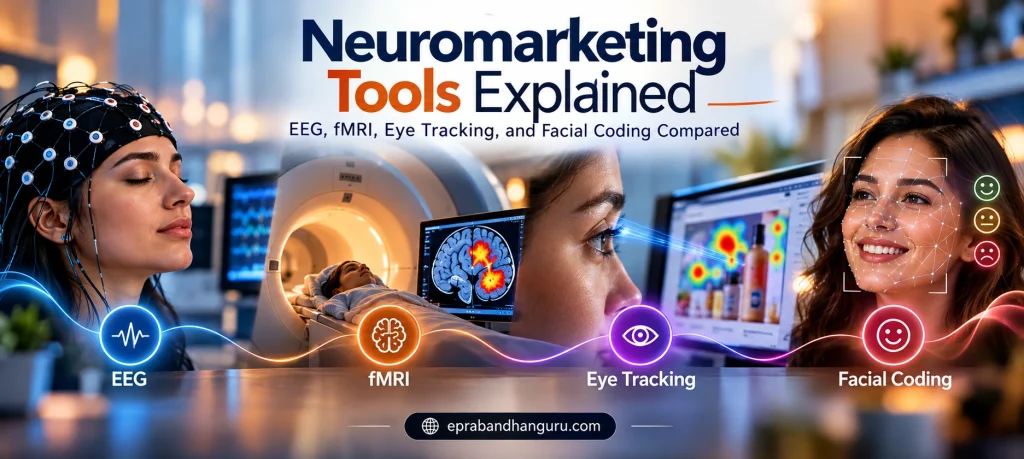
Neuromarketing Tools Explained: EEG, fMRI, Eye Tracking, and Facial Coding Compared

EEG, fMRI, eye tracking, or facial coding? Compare how each neuromarketing tool works, what it costs, and where it falls short, in plain English.

Neuromarketing Tools
Neuromarketing Tools Explained: EEG, fMRI, Eye Tracking, and Facial Coding Compared

1. Introduction

Here is a puzzle. Two ads look equally good on paper. Both get great scores in a survey. But one makes people buy, and the other does nothing.

Why? The answer may be hiding in places a survey cannot reach. Where did people look? How did their brain react? Did their body get excited, or did it shrug?

To find out, brands use special neuromarketing tools. There are four big names you will hear again and again: EEG, fMRI, eye tracking, and facial coding. They sound alike, but they do very different jobs. And one of them is a lot less reliable than its sales pitch suggests.

In this guide, we compare all four in plain English. If you want the big picture first, start with our post on how brands read your brain. Then come back here for the tools.

2. Quick Answer: The Four Tools at a Glance

neuromarketing-tools-infographic
Neuromarketing Tools Infographic
Tool What it reads Cost level Best for Biggest weakness
EEG Brain waves (electrical signals) Medium Video ads, attention, engagement Hard to interpret
fMRI Blood flow in the brain Very high Deep research on emotion and choice Costly and not portable
Eye tracking Where you look, and for how long Low to medium Packaging, websites, shelves Cannot tell why you look
Facial coding Muscle movements in your face Medium Extra data on video reactions Weak science behind emotion claims

Keep this table in mind. Now let’s open each tool and see how it really works.

2.1. EEG: The Stadium Microphone

2.1.1. How it works

EEG stands for electroencephalography. A headset with small sensors sits on your scalp. It picks up tiny electrical signals your brain makes all the time.

Think of a microphone hanging above a football stadium. It cannot tell you who is cheering. But it can tell you the exact moment the crowd roars. EEG works the same way. It does not show where in the brain something happens. It shows when.

2.1.2. What Brands Learn

Because EEG is so fast, it can track changes second by second. A brand can watch a video ad and see the moment attention rises, drops, or fades. That helps editors cut boring parts and keep the strong ones.

2.1.3. Cost and Limits

EEG is cheaper and more portable than a brain scanner. One research review found that devices range from about $99 for simple headsets to over $25,000 for lab-grade ones. (That review is a few years old, so prices today may differ.) 

The catch? The signals are messy. NMSBA, an industry group, notes that EEG results can be hard to read and often need expert skills to run and understand. Muscle movement and even blinking can add noise.

Best for: testing video ads and tracking attention over time.

2.2. fMRI: The Brain Heat Map

2.2.1. How It Works

fMRI stands for functional magnetic resonance imaging. You lie still inside a large scanner. It tracks changes in blood flow in the brain. When a brain area works harder, it uses more blood. The scanner spots that.

Think of a heat map on a weather app. The hot spots show where the action is. fMRI is great at showing where in the brain something happens. It is not so good at showing when, because blood flow is slow to change.

2.2.2. What Brands Learn

fMRI can show which brain areas light up when you look at a logo, taste a drink, or see a price. This makes it a strong tool for deep research. For example, the well-known cola brain-scan study we mentioned in our earlier post used this kind of imaging.

2.2.3. Cost and Limits

This is the big one. A research review estimates an fMRI machine can cost between $500,000 and $3 million. Even a single study session can cost several thousand euros, according to Donutz Digital.

You also have to lie still in a tube, which is a strange place to watch an ad. So fMRI is mostly used by universities and very large brands.

Best for: deep, academic-style research on emotion and decision making.

2.3. Eye Tracking: The Most Trusted Tool

2.3.1. How It Works

Eye tracking is simple to explain. Tiny cameras, often with infrared light, follow where your eyes move. They record what you look at first, what you skip, and how long you stare.

Think of it as following a finger across a page. Wherever your eyes go, your attention goes with them.

2.3.2. What Brands Learn

This is gold for design. A brand can see if shoppers notice the price tag. A website team can see if visitors find the “Buy” button. A package designer can see which side of the box wins the glance.

According to Deep Marketing’s 2026 review, eye tracking is the most proven neuromarketing tool for web design, packaging, and shelf placement.

2.3.3. Cost and Limits

Eye tracking is fairly affordable. The same review says a study with 30 to 50 real participants may cost roughly €5,000 to €15,000. Newer AI tools that predict where people will look start at about €500 to €2,000 a month. Webcam-based tracking is cheaper still, but it is less precise.

Here is the big limit. Eye tracking tells you where people look. It cannot tell you why. Someone may stare at a label because they love it, or because they are confused by it.

Best for: packaging, shelf layout, websites, and app design.

2.4. Facial Coding: The Tool to Be Careful With

2.4.1. How It Works

Facial coding uses software to watch your face while you view an ad. It tracks small movements in your facial muscles, like a raised brow or a lifted lip corner. Then it guesses which emotion you feel. 

It sounds clever. And it is easy to set up, since a normal camera is enough.

2.4.2. The Problem

Here is the uncomfortable truth. A face does not always show what a person feels. You may smile to be polite. You may frown when you are just thinking hard. The same expression can mean different things in different people and different cultures. 

Psychologist Lisa Feldman Barrett led a major 2019 review of this idea. It argued that you cannot reliably read a person’s emotion from their face alone. Deep Marketing’s guide agrees, and says selling facial coding as an objective emotion reader is scientifically wrong.

2.4.3. So Is It Useless?

Not quite. Facial coding can be a helper. If a viewer’s face shows a big reaction at the same moment their eyes or brain signals jump, that adds a clue. But it should never be the only proof.

Best for: extra data alongside other tools. Not as a stand-alone “emotion detector.”

2.5. A Bonus Tool: Skin Response (GSR)

You may also hear about GSR, or galvanic skin response. It measures tiny changes in sweat on your skin. It shows how excited or stressed you are.

The limit is clear, though. It shows the size of the reaction, not whether it was good or bad. A thrilling ad and a scary ad can look alike. So experts almost always pair GSR with other tools.

3. Head-to-Head: Which Tool Wins?

There is no single winner. Each tool answers a different question.

  • “Where do people look?” Use eye tracking.
  • “When does attention rise or fall?” Use EEG.
  • “Which part of the brain reacts?” Use fMRI.
  • “Is there an extra clue in the face?” Use facial coding, with care.

A good way to think about it is this. EEG is fast but blurry about location. fMRI is sharp about location but slow. Eye tracking shows attention but not feeling. Facial coding shows expression but not truth.

Every tool has a blind spot. That is why the smartest teams mix them.

4. Why Mixing Tools Works Better

A large review of EEG studies found something helpful. Predictions about what consumers prefer got better when EEG data was combined with other body measures, such as eye tracking or skin response.

It makes sense. One tool gives you a clue. Two or three tools give you a story.

There is a small warning, too. The same review notes that computer models can “overfit.” This means they look brilliant on the data they trained on, but fail on new people. So results should always be tested again.

5. How to Choose the Right Tool

Ask yourself three simple questions.

i. What do I want to know? Attention, emotion, or brain area?

ii. What is my budget? fMRI is for big budgets. Eye tracking and EEG suit smaller ones.

iii. What am I testing? A package or website suits eye tracking. A video ad suits EEG.

Small businesses and student projects usually do best with eye tracking, or with basic EEG and survey follow-ups. For most everyday questions, you do not need a brain scanner.

6. What This Means for Students

If you are studying marketing, psychology, or design, these tools can shape your career. Many firms need people who can read this kind of data and explain it in simple words.

A few tips to get started:

  • Learn basic statistics, since every study ends in numbers
  • Practise explaining a result in plain language
  • Study the ethics, because trust matters as much as data

This mix of data skills and people skills is exactly what we covered in Skills for 2030: Preparing Students for Future Careers. And since AI now helps analyse eye and brain data, our post on AI vs Human Creativity is a good next read.

7. The Privacy Question

All these tools collect body data. In a lab, volunteers agree to it. But as cameras and sensors spread into daily life, the line may blur.

That is why consent and clear rules matter so much. We dig into this idea in Personal Data: The New Currency of the Digital Age.

8. Quick FAQ

What is the most accurate neuromarketing tool? 

There is no single most accurate tool. Eye tracking is the best proven for design and packaging, while EEG and fMRI answer deeper brain questions.

Which neuromarketing tool is cheapest?

Eye tracking and basic EEG are the most affordable. fMRI is by far the most expensive.

Is facial coding reliable?

It is the weakest of the four for reading emotion. It works best as a supporting clue, not as proof.

Can small businesses use neuromarketing tools?

Yes. Webcam eye tracking, AI attention prediction, and simple EEG tests are within reach for many small teams.

9. Conclusion

Neuromarketing tools are not magic windows into your mind. They are more like different lenses. Each one shows a small part of the picture.

EEG shows timing. fMRI shows location. Eye tracking shows attention. Facial coding adds a hint, but only a hint.

The real skill is knowing which lens to use, and when to trust it. Next time you see a perfectly placed button or a pack that grabs your eye, you will know there may be a quiet experiment behind it.

So here is a question to take with you. If a brand could watch only one of your reactions, which one would tell the truest story?

Sources

Note: Equipment and study prices change often and vary by country and vendor. The EEG and fMRI device prices come from a 2022 research review, and the study-cost ranges come from European agency guides, so treat all figures as rough guides. The facial coding critique refers to a widely cited 2019 review by Lisa Feldman Barrett.

Posted in Consumer Behaviour | Tagged , , , , , , , , , , , , , , , , , , , , , , , , | 2 Comments

Neuromarketing: How Brands Read Your Brain (And What It Means for You)

Brands now track your eyes, brain waves, and gut reactions to sell more. Here is how neuromarketing works, what is real, and how to protect yourself.

Neuromarketing
Neuromarketing

1. Introduction

Think about the last thing you bought. Why that one? 

You probably have a neat answer. It was cheaper. It looked nice. A friend liked it. But here is a strange thought. Part of that choice may have been made before you could explain it. And somewhere, a brand may have studied exactly how your brain reacted to its colour, its price, or its ad. 

That is neuromarketing. It sounds like science fiction. It is already a multi-billion dollar industry. Let’s open the box and see what is really inside.

2. What Is Neuromarketing?

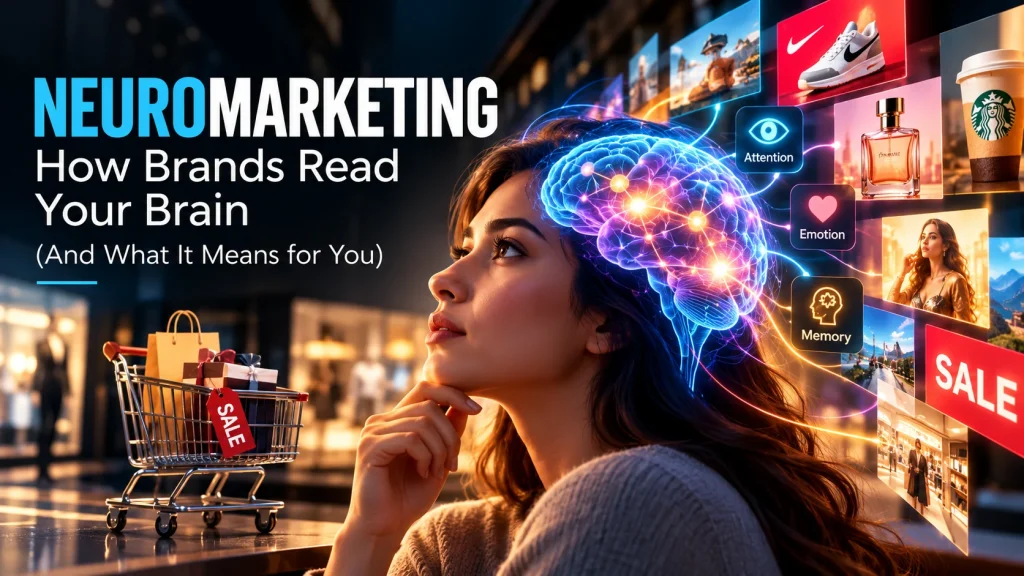
In simple words, neuromarketing mixes brain science with marketing. Instead of asking people what they like, it measures how their body and brain respond.

Why bother? Because asking does not always work. People often say one thing and do another. Sometimes we do not even know why we like something. A survey cannot catch that. A sensor sometimes can.

So brands now study three things:

  • Attention. What did you notice first?
  • Emotion. Did you feel something?
  • Memory. Will you remember it later?

If an ad gets attention, stirs a feeling, and sticks in memory, it has a better chance of making you buy. That is the whole idea.

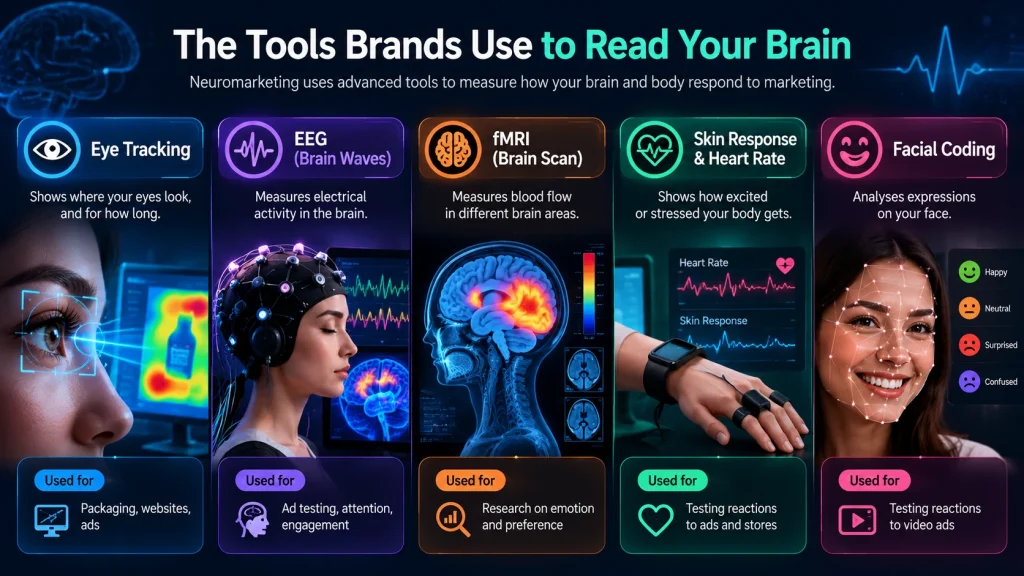
2.1. The Tools Brands Use to Read Your Brain

neuromarketing-tools-infographic
Neuromarketing Tools Infographic

You do not need a lab coat to understand these. Here is a quick guide.

Tool

What it measures

Where it is used

Eye tracking

Where your eyes look, and for how long

Packaging, websites, ads

EEG (brain waves)

Electrical activity in the brain

Ad testing, attention, engagement

fMRI (brain scan)

Blood flow in different brain areas

Research on emotion and preference

Skin response and heart rate

How excited or stressed your body gets

Testing reactions to ads and stores

Facial coding

Expressions on your face

Testing reactions to video ads

Most of this happens in research labs. Volunteers sit in front of a screen, wear a headset
or a sensor, and watch an ad or look at a product. Then the data shows which parts worked.


3. What Brands Learn From Your Brain

3.1. Where Your Eyes Really Go

Eye tracking is the most common tool. It shows which part of a package, a web page, or an ad gets looked at first. It also shows what gets ignored. 

A brand may think its logo is the star. The data may show people stare at the product photo instead. So the design changes.

3.2. How You Respond to Price


Ever noticed how many prices end in 9? A price of ₹499 feels smaller than ₹500, even though the gap is just one rupee. Researchers call this the left-digit effect. Our
brain reads the first number and judges the price from that.

It is a tiny trick. But across millions of sales, tiny tricks add up.


3.3. Why Some Ads Stick


Ads that tell a story and make you feel something are often remembered longer than ads that only list facts. Neuromarketing tests help brands find the exact moment in
a video where attention drops, or where emotion peaks.


3.4. Why You Love a Brand (Not Just a Product)


Here is a famous example. In a well-known 2004 brain-scan study, people tasted two cola drinks. When they did not know the brand, their choices were fairly even. When
they knew which was which, the brand name changed their brain activity and their preference.


The lesson is simple. We do not only taste the drink. We taste the story, the logo, and the memories around it.


3.5. How a Store Makes You Feel


Music, lighting, scent, and layout all shape mood. A slow song may make shoppers walk slower. A warm smell may make a shop feel friendly. These effects are usually small, and they depend on the setting. But brands test them anyway.

The Numbers Behind the Buzz


Neuromarketing is no longer a side experiment.


  • Research and Markets values the global market at about $3.71 billion in 2026, growing to $5.65 billion by 2030.
  • Other firms use different methods. Market Data Forecast puts it near $1.86 billion for 2026. So estimates range from about $1.8 billion to nearly $4 billion.
  • One market report from Polaris Market Research says eye tracking can lift ad conversion by up to 28%. It also says content shaped by EEG data can bring 23% more engagement than standard A/B testing.

A word of caution on those last two numbers. They come from a market research firm, not from a single independent trial. Treat them as a sign of the trend, not as a guarantee.

4. Can Brands Really Read Your Mind? Not Quite

Here is where we need to be honest. Neuromarketing is powerful, but it is also oversold.

According to Deep Marketing’s 2026 review, some methods have solid scientific support. These include well-run EEG and fMRI studies, and eye tracking for packaging and web design.

Other claims are mostly hype. These include reading a person’s exact emotions from their face, building secret “brain profiles” of shoppers, and using hidden messages at large scale.

So no, a brand cannot see your thoughts. What it can do is spot patterns in groups of people. That is still useful. But it is far from mind reading.

5. The Ethics Question: Where Does Persuasion End?

Good marketing has always tried to persuade. A bright poster, a catchy jingle, a “limited time” tag. None of that is new. Neuromarketing raises a sharper question. If a brand knows how your brain reacts, is it still fair persuasion? Or does it start to feel like pressure?

Most studies today use volunteers who agree to take part. That is a good start. The bigger worry is the future. As sensors move into phones, watches, and cameras, more of our body signals could become data. And as we explored in Personal Data: The New Currency of the Digital Age, data tends to get valuable fast.

Strong consent, clear rules, and honest brands will matter more every year.

6. What This Means for You: 6 Simple Habits

You do not need to fear neuromarketing. You just need to shop with open eyes.

  1. Pause before you buy. Wait 24 hours for non-essential items. Real wants survive the wait. Impulse wants often fade.
  2. Look past the price ending. Round ₹499 up to ₹500 in your head. Does it still feel like a good deal?
  3. Notice the mood triggers. Countdown timers, soft music, and “only 2 left” signs are built to speed you up. Slow down.
  4. Do not decide while tired or hungry. A calm mind makes cleaner choices.
  5. Cut the noise. Constant ads and alerts keep you in reaction mode. A little digital detox can sharpen your judgement.

Check app permissions. Camera, microphone, and location access can reveal more about you than you think.

7. What This Means for Students and Marketers

If you study marketing, neuromarketing is worth learning. It mixes psychology, data, and design. And it is growing alongside AI tools, which can now help analyse attention and emotion at speed. We touched on this human-versus-machine balance inAI vs Human Creativity: Who Wins?.

For your career, a few things help:

  • Learn basic consumer psychology and research methods
  • Get comfortable with data and simple statistics
  • Study ethics, because trust is now a brand asset
  • Practise telling emotional stories with clear facts

These are exactly the kind of mixed skills we covered in Skills for 2030: Preparing Students for Future Careers.

8. Quick FAQ

i. What is neuromarketing in simple words? It is the use of brain and body measurements to understand how people react to ads, products, and prices.

ii. Does neuromarketing really work? Some parts do, especially eye tracking and well-designed EEG studies. Other claims are exaggerated, so results depend on the method.

iii. Can a brand read my thoughts? No. Brands look at patterns across groups of people. They cannot see your private thoughts.

iv. Is neuromarketing manipulation? It depends on how it is used. Testing which ad is clearer is fair. Hiding how data is used, or pushing people when they are vulnerable, is not.

9. Conclusion

Neuromarketing is not magic, and it is not mind control. It is a set of tools that helps brands see what grabs your attention, what moves you, and what you remember.

Used well, it can make ads clearer, packaging simpler, and websites easier to use. Used badly, it can nudge people into choices they would not make on a calm day.

The best defence is simple awareness. The next time something feels like a perfect buy, pause. Ask yourself one question: Is this me deciding, or is it the design?

Once you start asking, you will never look at a shelf, a price tag, or an ad quite the same way again.

Resources

Note: Market size estimates differ widely between research firms because each defines “neuromarketing” differently. Performance claims such as the 28% and 23% lifts are reported by a market research firm and should be treated as indicative. The 2004 cola brain-scan study is described in general terms from well-known published research.

Posted in Consumer Behaviour | Tagged , , , , , , , , , , , , , , , , , , , , , , , , | 2 Comments

AI-Powered Recruitment: Opportunities, Challenges and the Future of Hiring

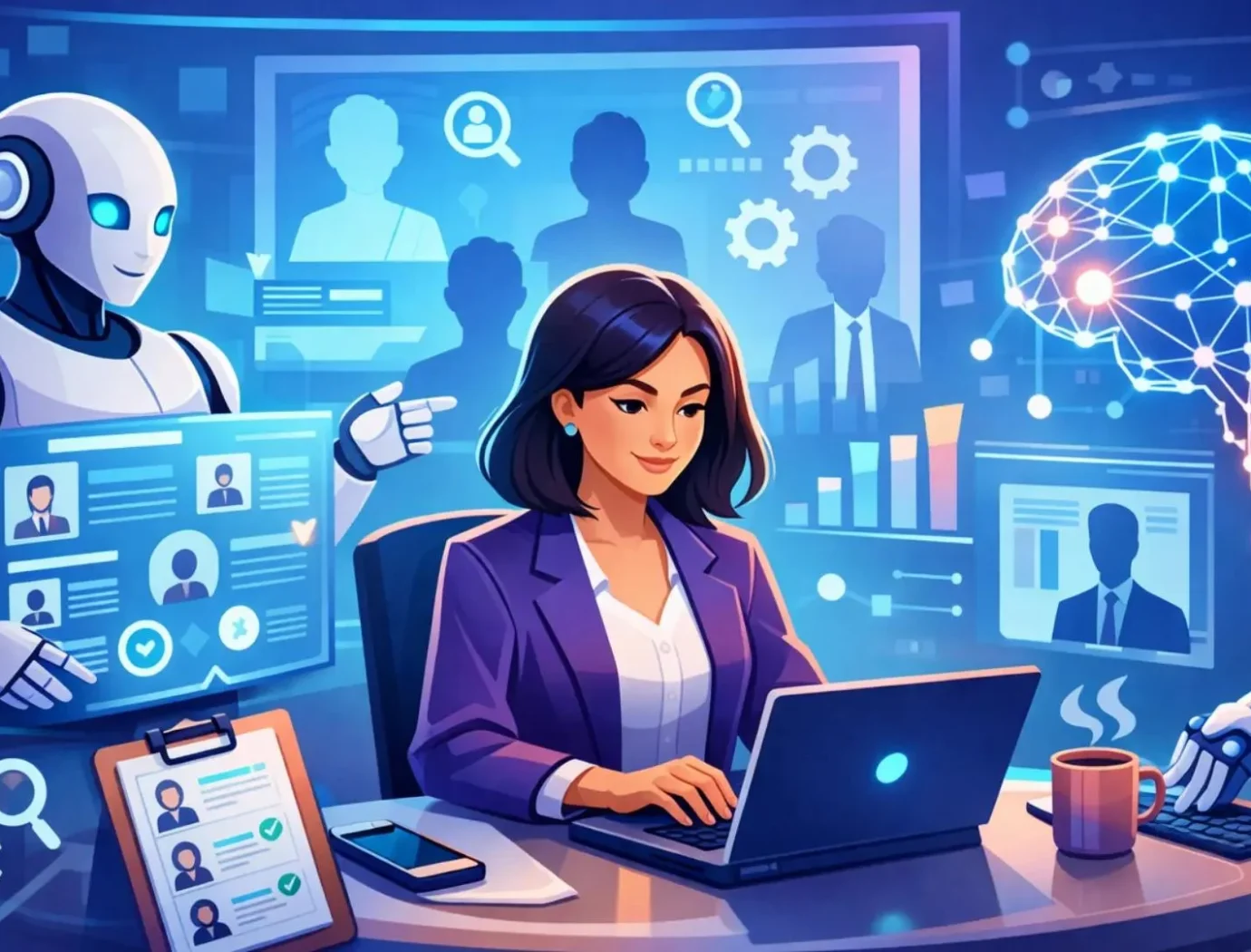
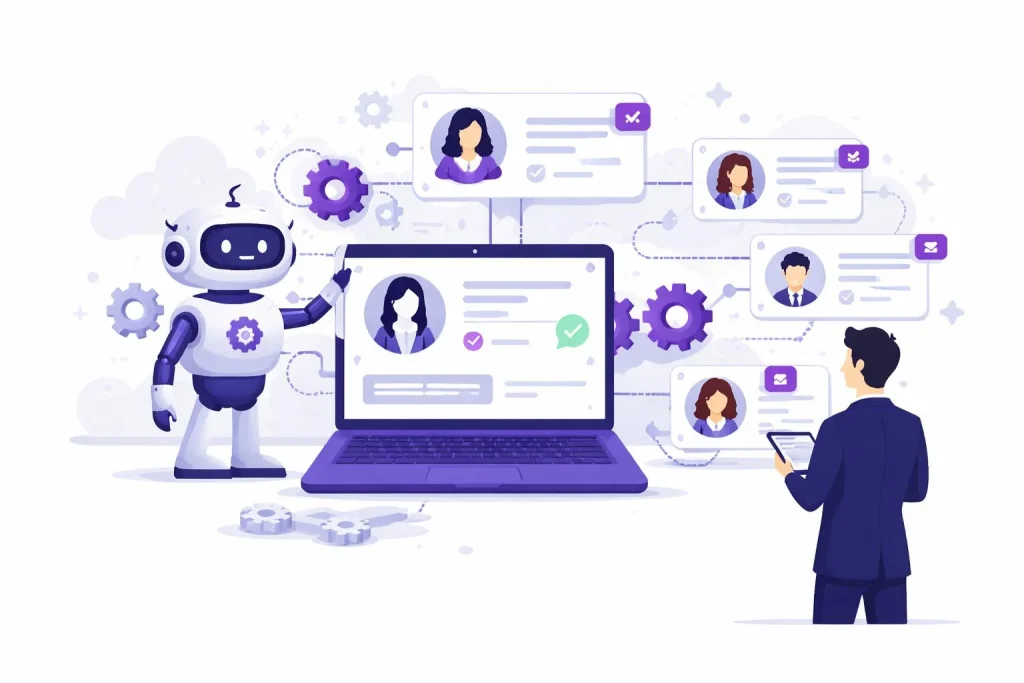
Human recruiter using AI to review job candidates
ai-powered-recruitment-future-hiring

Discover how AI-powered recruitment is changing hiring through automation, faster screening and better talent matching while addressing bias, privacy and human oversight.

First answer me “Would you trust AI to decide whether you get your next job?”

1. Introduction: Is Artificial Intelligence Changing the Way We Hire?


Imagine applying for a job and receiving a response within minutes. 

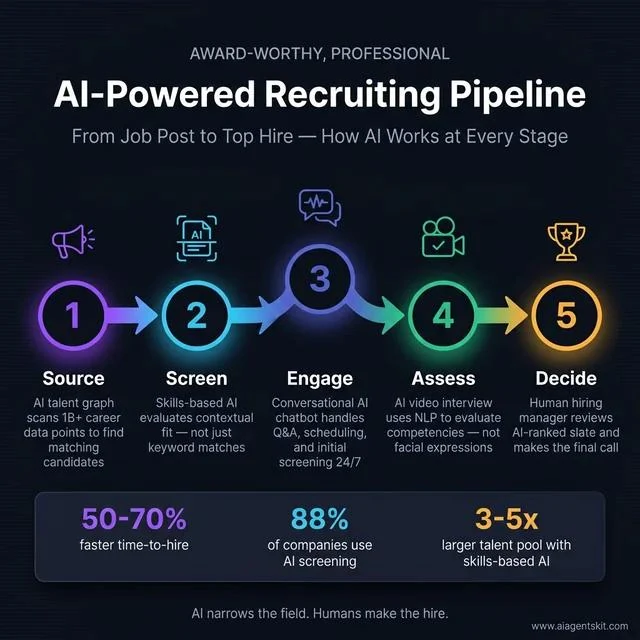
Your resume is scanned automatically. Your skills are matched with the job description. A chatbot answers your questions. An online assessment evaluates your abilities. A recruiter then reviews the most suitable candidates.


This may sound like something from the future, but it is already becoming part of modern recruitment.


Artificial Intelligence (AI) is changing the way organizations find, screen, evaluate, and communicate with job candidates.


For employers, the attraction is easy to understand. Recruitment can be time-consuming. A single job opening may attract hundreds or even thousands of applications. Recruiters have to read resumes, communicate with candidates, schedule interviews, compare qualifications, and maintain records.

AI can automate many of these repetitive activities.


But there is another side to the story.


When an algorithm helps decide who gets an interview, the consequences can be significant. A poorly designed system may overlook a talented candidate. Biased training data may produce unfair recommendations. Candidates may not know that AI is evaluating them. Personal information may also be processed on a large scale.


So the real question is not simply:


“Can AI recruit people?”


The more important question is:


“How can organizations use AI to make recruitment faster and better without losing fairness, transparency, and the human touch?”


That is where the future of AI-powered recruitment becomes interesting.


2. What Is AI-Powered Recruitment?


AI-powered recruitment means using artificial intelligence and related technologies to support different stages of the hiring process.


These technologies can help organizations:


  • Find potential candidates
  • Screen resumes
  • Match skills with job requirements
  • Communicate with applicants
  • Schedule interviews
  • Conduct assessments
  • Analyze recruitment data
  • Support recruiters in decision-making

AI does not necessarily mean that a machine makes the final hiring decision.


In a well-designed recruitment process, AI can work as an assistant to recruiters, helping them manage large amounts of information while humans remain responsible for important decisions.

This distinction is important. The goal should not be:


Human recruiters vs. AI


It should be:


Human recruiters + AI


3. Why Are Companies Turning to AI for Recruitment?


Recruitment has become more complex.


Organizations are competing for skilled employees while candidates have access to more information about employers and job opportunities than ever before.


At the same time, recruiters may receive huge numbers of applications for a single position.

AI can help organizations manage this complexity.


The World Economic Forum’s Future of Jobs Report 2025 projects major labour-market transformation by 2030, with 170 million jobs potentially created and 92 million displaced, resulting in a net increase of 78 million jobs. The report also highlights rapid changes in the skills employers need.


This changing employment environment makes effective talent identification increasingly important.

4. How AI Is Used in Recruitment

The AI-Assisted Recruitment Process

AI can be used at several stages of the recruitment journey.

4.1. Writing Job Descriptions

Recruiters can use AI tools to create clearer job descriptions. For example, AI can help:

  • Structure job advertisements
  • Identify missing skills
  • Improve readability
  • Suggest inclusive language
  • Create different versions for different platforms

However, recruiters should review AI-generated job descriptions carefully. An AI tool does not automatically understand the organization’s culture, legal requirements, or real expectations for a particular role.

4.2. Finding Candidates

AI can help identify potential candidates from:

  • Online job portals
  • Professional networks
  • Internal talent databases
  • Previous applicants
  • Recruitment platforms

Instead of manually searching through thousands of profiles, recruiters can use AI-supported systems to identify candidates whose skills appear relevant to a particular position. This can save considerable time.

4.3. Resume Screening

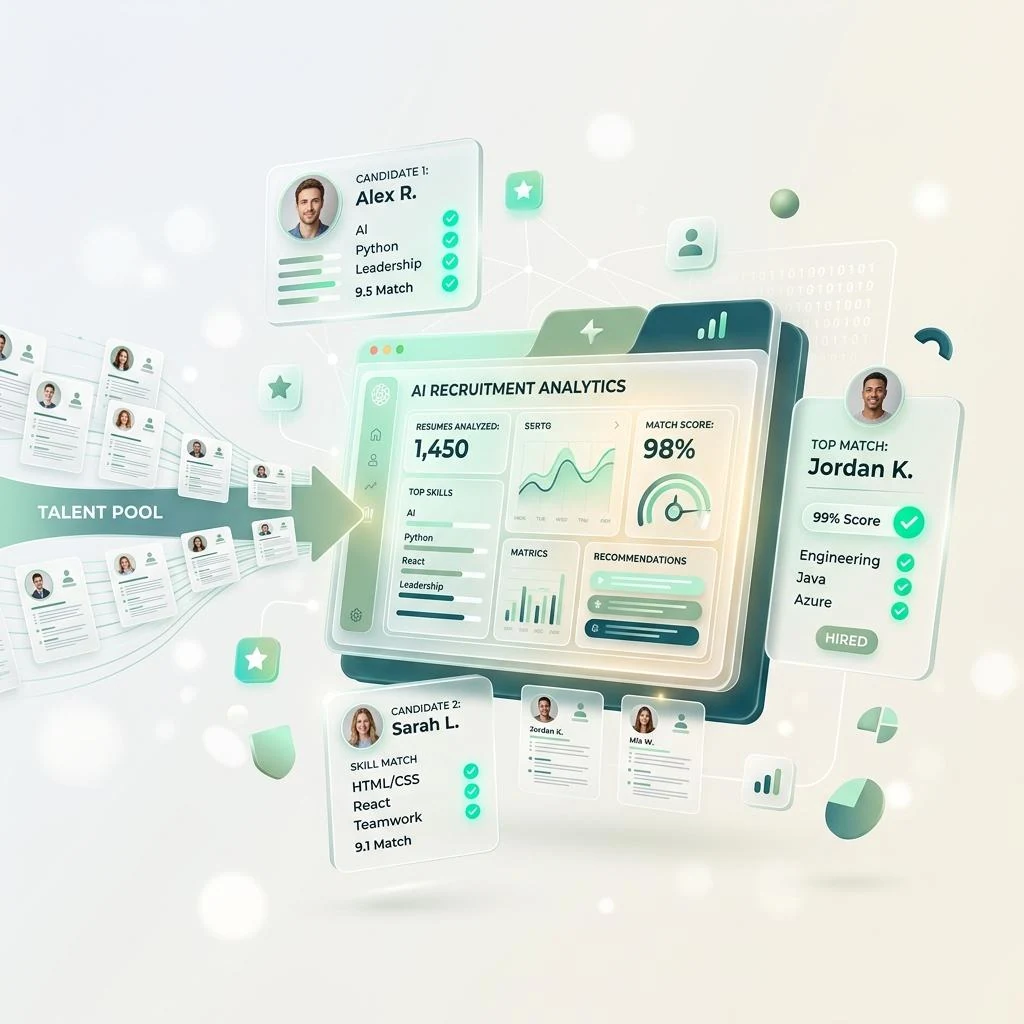
AI Resume Screening and Candidate Matching
How AI Identifies Relevant Candidate Skills


Resume screening is one of the most common applications of recruitment technology. An AI system can examine resumes and identify information such as:


  • Education
  • Work experience
  • Technical skills
  • Certifications
  • Job titles
  • Relevant keywords

The system can then help rank or group candidates for further review. However, keyword matching has an important limitation. A highly qualified candidate may use different terminology from the wording used in the job description.


For example, a candidate might write “customer relationship management”, while the job description uses “CRM.”


A sophisticated system may recognize the connection, but a simple keyword-based system might not. That is why AI screening should not become an unquestioned gatekeeper.


4.4. Candidate Matching


AI can go beyond keywords by comparing candidate skills with job requirements.


For example: Job requirement: Digital Marketing Manager


The system may look for experience in:

  • Search engine optimization
  • Social media marketing
  • Performance marketing
  • Marketing analytics
  • Content strategy
  • Customer acquisition

It may then identify candidates with similar skill profiles even when their resumes use different wording. This can help recruiters discover candidates who might otherwise be overlooked.


4.5. Chatbots for Candidate Communication


AI Chatbots and Candidate Communication

Recruitment chatbots can answer common questions from applicants.

Candidates may ask:

  • What are the eligibility requirements?
  • When is the application deadline?
  • What documents are required?
  • What is the interview process?
  • Is the position remote or hybrid?

Instead of waiting for a recruiter to respond, candidates can receive immediate answers. This can improve the overall candidate experience.

4.6. Interview Scheduling

Scheduling interviews sounds simple, but it can consume significant administrative time. AI-powered systems can coordinate:

  • Candidate availability
  • Recruiter availability
  • Interview panels
  • Time zones
  • Meeting links
  • Reminders

This allows HR teams to spend more time on meaningful interactions with candidates.

4.7. Assessing Candidates

AI can support online assessments involving:

  • Technical knowledge
  • Cognitive skills
  • Job-related competencies
  • Problem-solving
  • Language skills

Some systems may also analyze responses or patterns in assessment performance. However, assessment tools should be carefully validated.

A test should measure something genuinely relevant to the job rather than simply measuring how comfortable a candidate is with a particular technology.

4.8. Supporting Interview Processes

AI can also assist recruiters during interviews by:

  • Generating interview questions
  • Creating interview summaries
  • Organizing candidate notes
  • Comparing responses against predefined criteria
  • Identifying areas requiring follow-up

However, automated interpretation of facial expressions, voice patterns, or personality from video interviews deserves particular caution. Human behaviour is complex, and technology should not be treated as an infallible judge of personality or potential.

5. Major Benefits of AI-Powered Recruitment

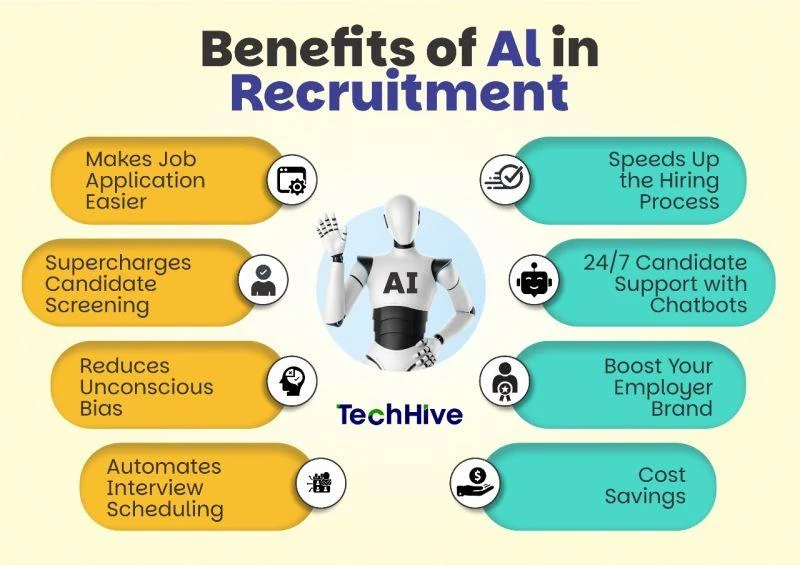
Major Benefits of AI-Powered Recruitment

5.1. Faster Hiring


One of the biggest dvantages of AI is speed. Tasks that might take hours can sometimes be completed much faster with automation. For organizations hiring at scale, this can make a significant difference.


5.2. Reduced Administrative Work


Recruiters often spend considerable time on repetitive tasks. AI can help automate:

  • Resume sorting
  • Interview scheduling
  • Candidate notifications
  • Data entry
  • Recruitment reports

This allows HR professionals to focus more on people rather than paperwork.


5.3. Better Candidate Matching


AI can identify relationships between skills, experience, and job requirements. This may help organizations identify candidates based on capabilities rather than relying solely on traditional resume formats.


5.4. Improved Candidate Experience


Fast communication matters. Candidates do not want to submit an application and hear nothing for weeks. Automated communication can provide:

  • Application confirmation
  • Status updates
  • Interview reminders
  • Frequently requested information

Even when a candidate is unsuccessful, clear communication can improve their perception of the organization.


5.5. Support for Recruiters


AI does not have to replace recruiters. Instead, it can help them handle large amounts of information. Think of AI as a co-pilot for recruitment. The recruiter remains responsible for judgment, empathy, context, and final decisions.


5.6. Recruitment Analytics


AI can help HR teams understand recruitment data. For example, organizations can examine:

  • Time to hire
  • Source of candidates
  • Application conversion rates
  • Interview-to-selection ratios
  • Recruitment costs
  • Candidate drop-off rates

These insights can help organizations improve their recruitment strategies.


6. Can AI Make Recruitment More Fair?


This is one of the most interesting questions. Human recruiters can have conscious or unconscious biases. AI is sometimes presented as a solution because machines do not have human emotions. But there is a problem:


AI learns from data, and data can contain human bias.


If historical hiring decisions favored a particular type of candidate, an AI system trained on that history may learn the same pattern.


For example, suppose a company historically hired more people from a particular educational background. An AI system might conclude that this background is associated with successful employees. It could then give similar candidates higher scores. The problem is that historical success does not necessarily mean the historical hiring process was fair.


7. The Risk of Algorithmic Bias

Bias can enter an AI recruitment system through:

  • Training data
  • Historical hiring decisions
  • Poorly selected variables
  • Incomplete datasets
  • Biased job descriptions
  • Proxy variables
  • Human assumptions built into the system

The U.S. Equal Employment Opportunity Commission has specifically warned that AI and automated systems used in recruitment and hiring can create discrimination risks. Existing employment discrimination protections still apply when AI is involved. This is an important lesson for organizations:


Using AI does not remove legal or ethical responsibility.


8. Privacy: Another Major Concern


Recruitment involves personal information.

A candidate may provide:

  • Name
  • Address
  • Phone number
  • Email
  • Educational qualifications
  • Employment history
  • Salary expectations
  • Assessment results

Some recruitment systems may process additional information. Organizations therefore need to think carefully about:


 What data are we collecting?

Why are we collecting it?

Who can access it?

How long will we keep it?

How will it be protected?


Candidates should not be expected to give up privacy simply because an organization uses advanced technology.

  1. The Transparency Problem

Imagine receiving an email saying:

“Your application was not selected.”

  • But you have no idea why.
  • Was your experience insufficient?
  • Was your resume rejected by an automated system?
  • Did the AI misunderstand your skills?
  • Was the position already filled?

Lack of transparency can create frustration and mistrust. Organizations should therefore provide reasonable information about how AI is being used in recruitment, particularly when automated tools significantly influence decisions.

10. The Human Touch Still Matters


Recruitment is ultimately about people. A resume cannot tell the complete story of a candidate. Consider two applicants:


Candidate A

  • Excellent academic record
  • Strong technical skills
  • Limited practical experience

Candidate B

  • Average academic record
  • Strong practical experience
  • Excellent communication
  • Strong problem-solving ability

Which candidate is better?


There may not be a simple answer. The best choice depends on:

  • Job requirements
  • Team environment
  • Organizational culture
  • Candidate potential
  • Learning ability
  • Leadership expectations

Human recruiters can consider context in ways that automated systems may struggle to capture.


11. AI Recruitment vs. Traditional Recruitment


Area

Traditional
Recruitment

AI-Powered Recruitment

Resume screening

Mostly manual 

Automated or AI-assisted

Candidate communication

Human-led

Human + chatbot

Scheduling

Manual coordination

Automated scheduling

Data analysis

Time-consuming

Faster analytics

Candidate matching

Recruiter judgment

AI-assisted matching

Scalability

Limited

High

Human interaction

High

Can vary

Bias risk

Human bias

Data + algorithmic bias

Transparency

Usually easier to explain

May be difficult with complex models

Decision-making

Primarily human

Should ideally remain human-led

The table shows that AI does not automatically make recruitment better. It changes the process. The quality of the result depends on how the technology is designed, implemented, monitored, and combined with human judgment.


12. What Should Organizations Do?


Responsible AI recruitment requires more than purchasing an AI software package. Organizations should establish clear practices.


12.1. Start With the Job, Not the Algorithm


First define:

  • What does the job actually require?
  • Which skills matter?
  • Which qualifications are essential?
  • Which characteristics are irrelevant?

Only then should an AI system be configured.


12.2. Test for Bias


Organizations should regularly examine whether the system produces significantly different outcomes for different groups. Testing should not happen only once. AI systems need continuous monitoring.


12.3. Keep Humans in the Loop


Important hiring decisions should receive appropriate human review. AI should provide recommendations—not unquestionable answers.


12.4. Explain the Process


Candidates should know when AI is being used in recruitment, particularly when it has a meaningful role in assessment or selection.


12.5. Protect Candidate Data


Recruitment systems should have strong security and clear data-handling practices.


12.6. Provide a Way to Ask Questions


Candidates should have an appropriate channel to seek clarification or request human
assistance when necessary.


12.7. Evaluate the AI System Regularly


A recruitment system that performed well two years ago may not perform equally well today. 

Job requirements change. 

Candidate pools change. 

Technology changes. 

Therefore, AI recruitment systems should be reviewed regularly.

  1. A Useful Framework for Responsible AI Recruitment

Organizations can think about AI recruitment through six simple principles:

F — Fairness: Does the system treat candidates fairly?

T — Transparency: Can candidates and recruiters understand how it is being used?

A — Accountability: Who is responsible for the outcome?

P — Privacy: Is candidate information protected?

H — Human Oversight: Can humans review important decisions?

E — Evaluation: Is the system regularly tested and improved?

Together, these principles create a simple F-T-A-P-H-E framework for responsible AI recruitment. The exact governance process should be adapted to the organization’s industry, location, legal obligations, and level of AI use.

  1. What the NIST AI Framework Can Teach HR Teams

Organizations looking for a structured approach to managing AI risks can also explore the NIST AI Risk Management Framework. NIST’s framework emphasizes trustworthy AI characteristics such as validity, reliability, safety, security, accountability, transparency, explainability, privacy, and fairness. It organizes risk management around four functions: Govern, Map, Measure, and Manage.

Although the framework is not specifically a recruitment manual, its principles can provide a useful foundation for organizations using AI in hiring.

15. What Does AI Recruitment Mean for Students and Job Seekers?


AI is changing the recruitment process, but it is also changing what employers look for. Students should not focus only on making a resume that passes an automated screening system. They should build genuine skills.


Important areas include:

  • Communication
  • Problem-solving
  • Digital literacy
  • AI literacy
  • Critical thinking
  • Creativity Adaptability
  • Teamwork
  • Domain knowledge

The World Economic Forum continues to emphasize the importance of both technology skills and human capabilities as the labour market changes.


For students, the message is simple:

Do not prepare only topass the AI screening system. Prepare to succeed after you get the job. 

Essential Skills for Job Seekers in the AI Era
  1. How Job Seekers Can Prepare for AI-Assisted Recruitment

Candidates can take several practical steps.

  1. Use Clear Resume Language: Describe skills and achievements clearly.
  2. Highlight Relevant Skills: Connect your skills directly to the requirements of the position.
  3. Show Results: Instead of writing:

“Worked on marketing campaigns.”

Consider:

“Supported digital campaigns that increased website enquiries.”

Specific evidence is easier for both humans and systems to understand.

4. Keep Your Resume Honest: Do not add skills simply because a job description mentions them. AI may help you get noticed, but interviews and actual work will reveal whether the skills are genuine.

5. Develop Human Skills: Communication, empathy, teamwork, creativity, and problem-solving remain important.

  1. Will AI Replace Recruiters?

Probably not in the simple way people sometimes imagine. AI may automate many recruitment tasks, but recruitment involves more than screening resumes.

Recruiters also:

  • Build relationships
  • Understand organizational culture
  • Communicate difficult decisions
  • Assess complex situations
  • Negotiate offers
  • Support hiring managers
  • Create positive candidate experiences

These responsibilities require human judgment.

The likely future is therefore not “AI replaces recruiters.”

It is: “Recruiters who use AI effectively may outperform recruiters who do not.”

This is an important distinction.

  1. The Future of AI-Powered Recruitment

Recruitment is likely to become increasingly data-driven and personalized.

Future systems may help organizations:

  • Identify skills rather than just job titles
  • Match candidates with career pathways
  • Predict future skill requirements
  • Recommend internal candidates for new roles
  • Support continuous talent development
  • Personalize candidate communication
  • Identify skill gaps within organizations

The World Economic Forum’s 2026 discussion of entry-level work also highlights how AI is reshaping how organizations hire, develop, and advance talent, particularly at the beginning of careers.

This means recruitment may gradually move from simply asking:

 “Who should we hire?”

to asking:

“What skills do we need, where can we find them, and how can we help people develop them?”

That is a much broader role for HR.

  1. The Biggest Opportunity: Better Human-AI Collaboration

The greatest opportunity may not be automation itself. It may be collaboration between humans and AI. AI is good at:

  • Processing large datasets
  • Finding patterns
  • Repeating tasks
  • Ranking information
  • Producing quick summaries

Humans are better positioned to:

  • Understand context
  • Show empathy
  • Make ethical judgments
  • Build relationships
  • Handle complex conversations
  • Consider organizational culture

When these strengths are combined properly, recruitment can become both more efficient and more human. The World Economic Forum has similarly highlighted that responsibly designed AI can potentially improve inclusion and transparency in recruitment, while stressing the need for careful risk management and governance.

A Simple Example

Consider a company receiving 5,000 applications for 100 vacancies. A traditional recruitment team might struggle to review every application carefully.

An AI-supported process could:

Step 1: Collect applications.

Step 2: Identify basic eligibility.

Step 3: Group candidates according to relevant skills.

Step 4: Identify potentially strong candidates.

Step 5: Send selected applications to human recruiters.

Step 6: Recruiters conduct structured interviews.

Step 7: Hiring managers make final decisions.

This model allows technology to handle volume while humans remain responsible for judgment.

That is probably a healthier way to think about AI-powered recruitment.

  1. AI Recruitment: Opportunity or Threat?

The answer is:

It can be either.

AI becomes an opportunity when it:

  • Reduces unnecessary administrative work
  • Helps identify suitable talent
  • Improves candidate communication
  • Supports recruiters
  • Provides useful insights
  • Encourages skills-based hiring

It becomes a threat when it:

  • Discriminates
  • Hides decision-making
  • Collects excessive personal data
  • Rejects qualified candidates unfairly
  • Removes meaningful human oversight
  • Treats algorithmic recommendations as unquestionable truth

The technology itself is not automatically good or bad. The way organizations design and use it matters.

  1. Conclusion: The Future of Recruitment Is Human + AI

AI-powered recruitment is changing the hiring landscape. It can make recruitment faster, more scalable, more data-driven, and potentially more consistent. Recruiters can spend less time on repetitive administrative work and more time engaging with candidates and hiring managers.

But AI also introduces serious challenges.

Bias, privacy, transparency, accountability, accessibility, and excessive automation must be taken seriously. A recruitment system can process thousands of applications in seconds, but speed is not the same as fairness.

The best approach is therefore not to choose between humans and machines. It is to combine their strengths.

AI can process the data. Humans can understand the person.

For organizations, the goal should be responsible AI adoption with strong governance and human oversight. For recruiters, the future will require both HR expertise and AI literacy.

For students and job seekers, building genuine skills will remain more important than simply learning how to satisfy an algorithm.

And for society, the central question will remain:

Can we use powerful technology to make hiring not only faster, but also fairer, more transparent, and more human?

The answer will depend less on the technology itself and more on the choices organizations make while using it.

Posted in Human Resource | Tagged , , , , , , , , , , | 7 Comments

Skills for 2030: Preparing Students for Future Careers (What Employers Really Want)

39% of job skills will change by 2030. Here are the skills students need now, and simple steps to build them before graduation. Discover the skills students need now and simple steps to build them before graduation.


Introduction


Here is a strange thought. Many students today are training for jobs that do not exist yet. That sounds dramatic, but the numbers back it up. Employers surveyed for the World Economic Forum expect 39% of key job skills to change by 2030. That is almost four out of every ten skills. A degree still matters, but on its own, it is no longer enough.


The good news? Change also brings opportunity. The same research expects 170 million new jobs to be created by 2030, while 92 million will fade away. That is a net gain of 78 million jobs.


So the real question for students is simple. Which skills will help you land those new jobs? Let’s find out.


Why Skills Matter More Than Ever


Think about how fast things have moved in just five years. Tools like AI assistants now write emails, sort data, and even draft code. Tasks that once took hours now take minutes.


This does not mean humans are out of the picture. It means the work is shifting. Machines handle repeat tasks. People handle the thinking, judging, and connecting parts.


The World Economic Forum’s Future of Jobs Report 2025 surveyed over 1,000 employers who together employ more than 14 million workers. Their biggest worry? Not money. Not competition. It was the skills gap. Employers say it is the top barrier to growing and changing
their business. For students, that gap is your opening.


The Skills That Will Matter Most by 2030


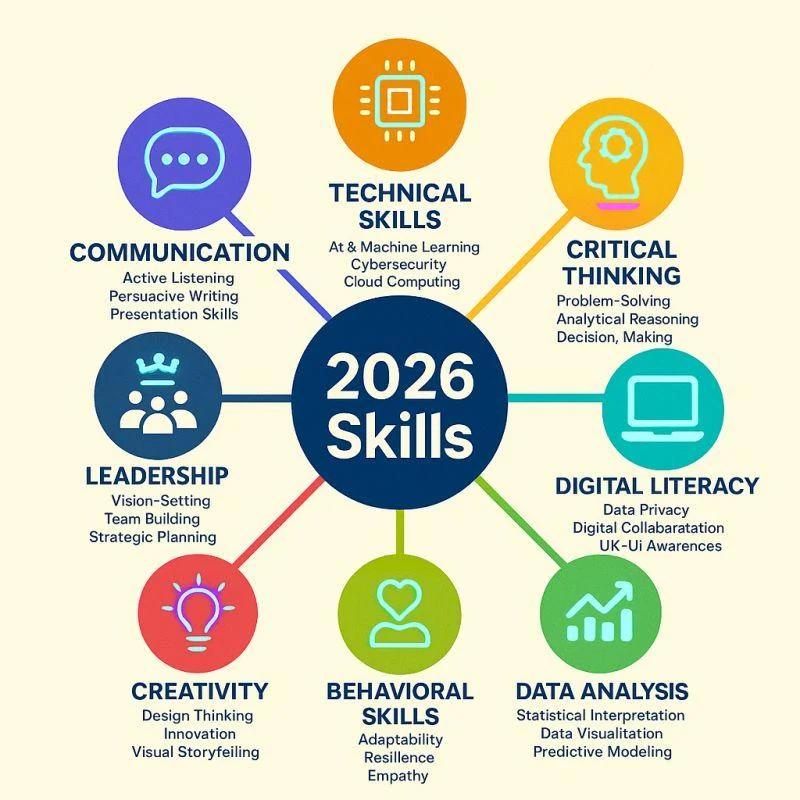
Let’s break the list into two groups: tech skills and human skills. You need a mix of both.


Tech Skills


1. AI and data literacy. You do not need to become a programmer. But you should know how to use AI tools well, check their answers, and read basic data. According to the WEF, AI and big data sit at the top of the fastest-growing skills list.


2. Cybersecurity awareness. Every company now lives online, so every company needs people who understand digital safety. Networks and cybersecurity rank right behind AI in growth.


3. Basic tech comfort. This means being at ease with new apps, cloud tools, and digital workflows. Technology skills are growing faster than any other skill group.


Human Skills


4. Analytical thinking. This is the ability to look at a messy problem, break it into parts, and find a clear answer. Employers rank it as the most important skill today.


5. Creative thinking. Machines can produce ideas, but people still lead when it comes to fresh, original thinking. If you are curious about this debate, read our take on AI vs human creativity.


6. Resilience and flexibility. Plans change. Jobs change. People who bounce back quickly and adapt will always have an edge. 


7. Curiosity and lifelong learning. The best learners in 2030 will be those who never stop learning. Your degree is the start, not the finish line.


8. Leadership and social influence. Even in your first job, you will need to persuade, guide, and work with others. Teamwork and clear communication never go out of style.


9. Environmental awareness. As companies work toward cleaner operations, green skills are opening new career paths. India is a good example, where clean power is creating fresh roles. See our guide on renewable energy opportunities in India.


10. Empathy and people skills. Care jobs, teaching, counselling, and customer roles are all growing. Machines cannot truly understand how a person feels. You can.


Which Jobs Are Growing?


Skills matter because they lead to jobs. According to the WEF, the biggest growth areas include:


  • Farmworkers and food processing, driven by the green transition and rising demand
  • Delivery drivers, thanks to online shopping
  • Software developers, as every business goes digital
  • Building and construction workers
  • Care roles, such as nurses, social workers, and counsellors, because populations are
    ageing

On the other side, clerical and data-entry roles are shrinking as automation takes over repetitive tasks. The message is clear. Jobs that need human judgment, care, or technical skill are safest.


Quick Snapshot: The 2030 Job Market


Fact

Number

New jobs created by 2030

170 million

Jobs displaced by 2030

92 million

Net job growth

78 million

Skills expected to change

39%

Employers who see skills gaps as top barrier

63%

Employers planning to upskill staff

85%

Source: World Economic Forum, Future of Jobs Report 2025, as summarised by Coursera.


How Students Can Start Preparing Today


You do not need to wait until graduation. Small steps, taken early, add up fast.


  1. Pick one AI tool and learn it well. Use it for research, summaries, or practice questions. Then always double-check what it tells you.
  2. Take a short online course each semester. Platforms like Coursera and NPTEL offer
    free or low-cost options in data, communication, and more.
  3. Work on real projects. A small project, a club event, or a class assignment done
    well teaches more than passive reading.
  4. Do an internship, even a short one. Two months of real experience shows employers you can handle work, not just exams.
  5. Practise speaking and writing. Join debates, present in class, or start a simple blog.
    Clear communication helps in every career.
  6. Build a habit of asking “why.” Curiosity is a skill. The more questions you
    ask, the sharper your thinking becomes.
  7. Look after your focus. Constant scrolling drains attention. A little digital
    detox
    can help you study and think better.
  8. Try something entrepreneurial. Even a small side idea teaches problem-solving and
    risk. Just learn from the common reasons startups fail first.

What Colleges and Teachers Can Do


Students do not carry this alone. Colleges play a big part.


  • Teach skills alongside subjects, such as teamwork, presentation, and data basics
  • Connect classrooms with industry through guest talks, live projects, and internships
  • Encourage cross-subject learning, so a business student can learn basic coding, or an engineer can learn communication
  • Offer regular short courses so learning never stops after exams

When schools and industry work together, students step into jobs far better prepared.


Common Mistakes to Avoid


  • Chasing only marks. Grades open doors, but skills keep them open.
  • Ignoring soft skills. Many people lose interviews because of weak communication, not
    weak knowledge.
  • Fearing AI instead of learning it. People who use AI well will likely outperform
    those who avoid it.
  • Waiting for the “perfect” course. Start with something small today.


Conclusion


The world of work in 2030 will look different, but it will not be closed to you. In fact, it will be open to anyone who is willing to learn, adapt, and keep growing.


Focus on a mix of tech skills and human skills. Stay curious. Build real experience while you study. And remember that skills are built one small step at a time. 


The students who thrive by 2030 will not be the ones who knew the most on graduation day. They will be the ones who never stopped learning after it.


Sources


  1. World Economic Forum— Future of Jobs Report 2025: The jobs of the future and the skills you need to get them
  2. World Economic Forum— Future of Jobs Report 2025: 78 Million New Job Opportunities by 2030
  3. World Economic Forum — The Future of Jobs Report 2025 (full report)
  4. World Economic Forum — Skills outlook chapter
  5. Coursera Blog — WEF Future of Jobs Report 2025 reveals a net increase of 78 million jobs by
    2030
  6. Skills That Count — WEF Future Of Jobs Report 2025: 39% Of Skills Change By 2030

Note: Job-growth and skills figures come from the WEF Future of Jobs Report 2025, which surveyed 1,000+ employers across 55 economies. Some blogs quote older 2020 figures (such as 85 million displaced and 97 million new jobs), so this post uses the latest 2025 numbers only.

Posted in Digital Marketing | Tagged , , , , , , , , , , , , , , , , , , , , , , , , | 1 Comment

Personal Data: The New Currency of the Digital Age (And What It’s Really Worth)

Every click, scroll, and search you make is worth money to someone. Here’s how personal data became the world’s most valuable currency — and how to protect yours. Every click and scroll has a price tag. Here’s how personal data became the world’s most valuable currency — and how to protect yours.


1. Introduction


Quick question: when was the last time you actually paid for an app?


Probably not recently. Most of the apps on your phone are free. Free to download, free to use, free to scroll through for hours. But here’s the thing about “free” — it almost never really is. If you’re not paying with money, you’re paying with something else: your data. Your location, your search history, your shopping habits, even how long you pause on a photo before scrolling past it.


That’s not a conspiracy theory. It’s simply how most of the modern internet makes money. And in 2026, this idea has gone from a niche privacy concern to one of the biggest conversations in tech, business, and government. Personal data has quietly become the new currency of the digital age — and unlike money, most of us are spending it without even realizing it.


2. Wait, How Is Data Actually “Currency”?


Currency is just something valuable that gets exchanged for goods or services. Normally that’s cash. But increasingly, companies are willing to give you something — a free app, a personalized recommendation, a discount — in exchange for your personal information instead.


Think about it this way: a free social media app doesn’t make money from your subscription. It makes money by learning exactly what you like, then selling advertisers the ability to show you the “right” ad at the right moment. Your attention and your data are the actual product being sold — you’re not the customer, you’re the currency.


This isn’t a small side industry either. Personal data is now estimated to be worth hundreds to thousands of dollars per person annually, once you add up everything collected across the legitimate advertising economy and the shadier markets where stolen or leaked data gets resold.


3. Every Click Has a Price Tag


Here’s where it gets a little uncomfortable. Nearly everything you do online quietly generates value for someone else:


  • Search history: tells companies what you’re interested in, worried about, or planning to buy.
  • Location data: reveals where you live, work, shop, and travel — valuable for targeted
    local ads.
  • Purchase history: shows exactly what you’re willing to spend money on, and how much.
  • Social media: activity — likes, follows, even how long you linger on a post — builds
    a detailed profile of your personality and preferences.
  • Voice and photo data: are now feeding a newer market too: training data for AI models, which has become its own monetization channel as personal content like
    photos and writing gets used to train AI systems.

None of this happens through one dramatic moment. It happens quietly, constantly, in the background — which is exactly why most people don’t think about it the way they’d think about handing over cash.


4. The Numbers Are Bigger Than You’d Think


If you want proof that this isn’t a fringe idea anymore, look at the numbers. Data privacy and personal data have become genuinely massive economic and political issues in 2026:


  • 144 countries now have national data privacy laws, covering roughly 82% of the
    world’s population
    — a huge jump from around 100 countries just a decade ago.
  • 82% of internet users say they’re genuinely concerned about how companies collect and use their personal data.
  • 82% of consumers admit they’ve actually walked away from a brand in the past year over concerns about how their data was handled — this isn’t just an opinion people hold; it’s changing real buying behavior.
  • 73% of consumers say they’re willing to share personal data — but only when they get something clearly valuable in return, showing that people aren’t against sharing data entirely, just against sharing it for nothing.
  • The global average cost of a data breach hit $4.44 million in 2025, with the U.S. average reaching a record $10.22 million.
  • The global data privacy software market is worth about $5 billion in 2026 and is
    projected to grow to roughly $45 billion by 2032 — a sign of just how seriously businesses are now taking data protection.
  • 71% of U.S. adults believe growing AI use will make their personal information
    less secure, not more.

Put simply: people have noticed. Governments have noticed. And businesses are now spending serious money to keep up.


5. Why This Matters More Than Ever in the Age of AI


AI has poured fuel on this fire in ways most people haven’t fully caught up with yet.

Modern AI systems need enormous amounts of data to learn and improve — and a lot of that data is personal: your writing style, your photos, your voice recordings, your online behavior. This has created a genuinely new category of value around personal content that didn’t really exist in the same way a few years ago.


At the same time, AI is creating new risks. A striking number of employees — 57% in one recent survey — admit to entering sensitive or high-risk information into public AI tools, often without thinking twice. Businesses are scrambling to catch up: privacy-related concerns tied specifically to generative AI jumped from 22% in 2025 to 34% in 2026, and it’s now considered a leading security concern by security leaders worldwide.

In short, AI hasn’t just made personal data more valuable — it’s made protecting it a lot more complicated.


6. Who’s Actually Winning (and Losing) in the Data Economy?


Winning:

  • Big Tech platforms that built entire business models around collecting, analyzing, and monetizing user data through advertising.
  • Data brokers— companies most people have never heard of, whose entire business is buying, packaging, and reselling personal information.
  • AI companies now paying for or licensing access to large volumes of personal content to train their models.

 Losing (or at risk):

  • Everyday users, who generate the data but rarely see a direct financial return for it.
  • Businesses that get it wrong — nearly half of consumers say they’ve switched companies over poor data practices, and trust, once broken, is expensive to rebuild.
  • Anyone caught in a breach — with average breach costs now well into the millions, this isn’t just a consumer problem; it’s a serious business liability too.

This imbalance — where a handful of companies profit heavily while individuals get very little back — is exactly why regulation has expanded so fast, and why “data as currency” has become as much a policy conversation as a business one.


7. How to Actually Protect the Value of Your Own Data


You can’t opt out of the digital economy completely — realistically, nobody does. But you can be a lot more deliberate about what you give away.


  1. Read the “value exchange,” not just the privacy policy. Ask yourself: what am I actually getting for this data? Sometimes it’s worth it. Often, it isn’t.
  2. Use privacy settings that actually exist. Most apps let you limit location tracking, ad personalization, and data sharing — most people just never open the settings menu.
  3. Turn on two-factor authentication everywhere. This single habit dramatically reduces the damage a leaked password or credential can do.
  4. Be cautious with AI tools at work. Avoid pasting sensitive personal or company information into public AI assistants unless you know exactly how that data is handled.
  5. Use a password manager and unique passwords. Reused passwords are one of the easiest ways for a single data leak to snowball into a much bigger problem.
  6. Ask “would I say this out loud in public?” before sharing something online. If not, think twice before typing it into a form, app, or chat.

None of these steps make you invisible — but together, they meaningfully shrink how much of your personal “currency” is up for grabs.


8. What This Means for Businesses


For companies, the message from 2026’s data shows something important:


privacy isn’t just a legal checkbox anymore — it’s becoming a genuine competitive advantage. The vast majority of organizations now report that privacy investment pays for itself, with a median return of 1.6x. Meanwhile, businesses that mishandle data are visibly losing customers over it. The businesses winning trust in this new economy tend to do three things well: they explain clearly why they need data, they give users real control over it, and they treat a data breach as a serious business risk — not just an IT problem.


9. Conclusion


Personal data didn’t become valuable overnight — it happened quietly, one free app and one “accept all cookies” click at a time. But in 2026, that quiet shift has turned into one of the defining economic stories of the digital age. Data is now currency, whether we consciously treat it that way or not.


The good news is that awareness is the first real step toward control. Once you understand that your searches, your location, and even your voice have real market value, you start making different choices about what you give away — and who you trust with it. In a world running on data, being a little more deliberate with yours isn’t paranoia. It’s just smart spending.


Sources


  1. Enzuzo — 70+ Data Privacy Statistics You Need to Know in 2026
  2. Secureframe — 110+ Data Privacy Statistics: The Facts You Need To Know In 2026
  3. StationX — Data Privacy Statistics [2026]: 56+ Laws, Fines & Trends
  4. SQ Magazine — Customer Data Privacy Statistics 2026: What Matters Most
  5. Lunyb — How Much Is Your Personal Data Worth in 2026? The Real Price Tag
  6. Folio3 — 65+ Data Privacy Statistics 2026 | Key Breaches & Insights


Note: Figures are drawn from industry surveys (Cisco, IBM, Pew Research, Thales, CookieYes) as reported in the sources above, current as of 2026. For business or compliance decisions, verify against the original primary research reports.

Posted in Digital Marketing | Tagged , , , , , , , , , , , , , , , , , , , , , , , , , , , | 4 Comments

Renewable Energy Opportunities in India: Where the Real Growth Is (2026)

India just hit 291 GW of renewable capacity — and it’s only getting started. Here’s where the real opportunities are, explained simply. India’s renewable capacity hit 291 GW and is racing toward 500 GW. Here’s where the real investment and career opportunities are.


1. Introduction


Here’s a fact that might surprise you: India hit its 2030 clean energy target five years early. By mid-2025, roughly half of the country’s total installed electricity capacity was already coming from non-fossil fuel sources — solar, wind, hydro, and more. Most countries are still chasing this kind of goal. India already crossed the finish line and kept running.


By July 2026, India’s installed renewable energy capacity had climbed to 291.73 GW, with another 17 GW added in just four months. The country is now the world’s third-largest solar market, sitting behind only China and the United States in total renewable capacity. And the government’s real target isn’t 291 GW — it’s 500 GW by 2030.


That gap between where India is and where it’s headed isn’t a problem. It’s an opportunity — for investors, entrepreneurs, engineers, job seekers, and everyday households alike. Let’s walk through exactly where that opportunity is showing up, in plain, simple terms.


2. Why India, Why Now?


A few things are lining up at the same time, and together they’re creating a rare window.


First, the sun is doing most of the heavy lifting. Solar alone makes up over 164 GW of India’s renewable capacity — more than half the total. India added a record 27 GW of new solar capacity in just the first half of 2026, up 49% from the same period the year before. Few countries have this much reliable sunshine paired with this much government push behind it.


Second, money is pouring in. According to the International Energy Agency, India is on track for a record $170 billion in total energy investment in 2026, with solar PV as one of the biggest drivers. Separately, foreign direct investment in India’s renewable sector has grown from around $195 million in FY11 to over $4 billion in FY25 — a 20x jump in little more than a decade.


Third, the government has removed a lot of the red tape. 100% foreign direct investment is now allowed under the automatic route for renewable energy generation and distribution — meaning international investors don’t need special approval to enter the market. That’s a rare level of openness in the energy sector, and it’s a big reason global capital keeps showing up.

Put simply: the sun is out, the money is moving, and the doors are open. That combination doesn’t happen often.


3. Where the Real Opportunities Are


3. 1. Solar Power — Still the Biggest Game in Town


Solar isn’t just leading India’s renewable growth — it’s carrying it. It’s expected to account for more than 60% of India’s total renewable capacity growth through 2030. Opportunities here span everything from utility-scale solar parks (India already has 50 solar parks running across multiple states) to rooftop installations for homes and businesses.


Speaking of rooftops — nearly 4.5 million households had installed rooftop solar under the government’s PM Surya Ghar programme by June 2026, reaching about 45% of a 10-million-household target. That means over half the target is still unmet. For solar installers, financing companies, and equipment makers, that’s a massive, still-open market sitting right in front of them.


3.2. Wind Energy — Quietly Scaling Up


Wind doesn’t get as much attention as solar, but the numbers are still impressive. Capacity has grown two-and-a-half times over — from 21 GW in 2014 to nearly 53 GW by mid-2025 — and the government is targeting almost 100 GW by 2029-30. States like Gujarat, Rajasthan, Tamil Nadu, Karnataka, and Maharashtra are leading the charge, making them hot spots for wind-project developers, turbine manufacturers, and skilled technicians.


3.3. Battery Storage — The Missing Piece Everyone’s Racing to Fill


Here’s a problem renewable energy has always had: the sun doesn’t always shine, and the wind doesn’t always blow. Battery storage is what solves that — storing extra power for when it’s needed. Major players like Adani Green are already building large battery storage portfolios alongside their solar and wind assets, and this is widely seen as one of the fastest-growing segments in the entire sector for 2026 and beyond. If you’re looking for where the next boom is likely to happen, storage is a strong bet.


3.4. Green Hydrogen — The Long-Term Bet


Green hydrogen is still an emerging piece of India’s clean energy puzzle, but it’s being taken seriously at a policy level, with production incentives and infrastructure planning already underway. It’s not the biggest opportunity today, but for investors and entrepreneurs thinking five to ten years ahead, it’s one of the spaces worth watching closely.


3.5. Transmission and Grid Infrastructure — The Unsexy Opportunity Nobody Talks About


You can build all the solar parks and wind farms you want, but none of it matters if the power can’t actually reach homes and factories. Grid congestion and transmission delays are becoming a real bottleneck — which is exactly why the government allocated funding to the Green Energy Corridor for building 6,000 km of new transmission lines. For engineers, contractors, and infrastructure investors, transmission and grid modernization is one of the least glamorous but most necessary opportunities in the entire sector.


3.6. Manufacturing — Making the Equipment India Needs


India isn’t just installing solar panels and wind turbines anymore — it’s increasingly making them at home. Production-linked incentive schemes are pushing domestic manufacturing of solar modules, cells, and related components. Companies like ReNew are now combining renewable generation with their own domestic manufacturing operations. For manufacturers and component suppliers, this “Make in India for clean energy” push is opening up an entirely new supply chain to build.


3.7. Jobs and Skilled Careers


All this construction, installation, and manufacturing needs people. As capacity keeps expanding toward the 500 GW target, demand is rising steadily for solar technicians, wind engineers, project managers, grid specialists, and skilled tradespeople. If you’re early in your career or considering a switch, clean energy is one of the more future-proof industries to build skills in right now.


4. The Numbers That Show the Scale of the Opportunity


Renewable Energy Fact (India)

Figure

Total installed renewable capacity (July 2026)

291.73 GW

Government’s 2030 non-fossil capacity target

500 GW

Solar capacity

164.59 GW

Wind capacity

58.14 GW

New solar added in H1 2026

27 GW (up 49% year-on-year)

Total energy investment expected in 2026

~$170 billion

FDI allowed in renewable generation/distribution

100% (automatic route)

Rooftop solar households reached (of 10M target)

~4.5 million (45%)


5. The Challenges Worth Knowing About


No opportunity comes without friction, and being upfront about it actually makes the picture more useful.


  • Grid bottlenecks. As mentioned above, transmission delays can hold back even well-funded, well-built projects.
  • Coal still dominates day-to-day power. Despite the renewable boom, coal remains the backbone of India’s electricity generation and continues to see billions in fresh investment — the transition is real, but it’s gradual, not overnight.
  • Regional concentration. Over 70% of India’s renewable potential is concentrated in just six states, meaning opportunity isn’t evenly spread across the country.
  • Land and financing hurdles. Large-scale solar and wind projects still need land acquisition and long-term financing, which can move slower than the technology itself.

None of this cancels out the opportunity — it just tells you where to look more carefully before jumping in.


6. What This Means If You’re Thinking About Getting In


  • Investors can look at listed renewable energy companies, green bonds, or direct project financing, especially in storage and transmission — areas that are growing fast but get less attention than solar headlines.
  • Entrepreneurs have real openings in rooftop solar installation, storage solutions, and even software that helps manage renewable assets and grid data.
  • Job seekers should consider skilling up in solar and wind technical roles, project management, or grid engineering — demand is only going one direction.
  • Everyday households can tap into rooftop solar subsidies, which still have millions of unclaimed spots under current government programs.

This isn’t a “someday” opportunity. It’s happening in real time, and the gap between today’s 291 GW and tomorrow’s 500 GW target is exactly where the next wave of growth will come from.


7. Conclusion


India’s renewable energy story isn’t a future promise anymore — it’s a present-day boom, backed by real capacity, real investment, and real policy support. Solar is leading, wind is scaling, storage is emerging as the next big race, and the infrastructure connecting it all is finally getting the attention it deserves. Whether you’re an investor, a founder, a student, or simply someone curious about where the country is heading, the renewable energy sector in India isn’t just growing — it’s one of the clearest, most open opportunities the country currently has to offer.


The sun’s already up. The only question left is who moves fast enough to make the most of it.


Sources

  1. Invest India — Investment Opportunities in Renewable Energy
  2. Tata Power — Renewable Energy Trends in 2026: What’s Ahead and Beyond
  3. Insights on India — Energy Statistics India 2026: Key Highlights, Challenges & Energy Security Analysis
  4. IBEF — Indian Renewable Energy Industry Analysis
  5. GreentechLead — India Renewable Energy Market 2026: Capacity Hits 291.73 GW
  6. Wikipedia — Renewable Energy in India
  7. IBEF — India’s Renewable Energy Growth: Solar Power & More
  8. IndexBox — India Energy Investment 2026: Record $170 Billion

Note: Capacity figures vary slightly by reporting date (April, May, July 2026) as India’s renewable sector is expanding rapidly month over month. All figures are cited to their original source with the relevant date for transparency.

Posted in Entrepreneurship | Tagged , , , , , , , , , , , , , , , , , , , , , , , , , , | 2 Comments

Circular Economy: The Future of Sustainable Business (And Why It Pays Off)

Description: The circular economy market is racing toward $890B by 2030. Here’s why “reuse” is becoming business’s smartest strategy. Throwing things away is going out of style. Here’s why the circular economy is quietly becoming the smartest business move of 2026 — and how companies are cashing in on it.


1. Introduction


Picture the old way of doing business: take resources, make a product, sell it, and once the customer is done with it, it ends up in a landfill. Simple, but wasteful. This is called a “linear economy,” and for over a century, it’s basically been the only game in town.


Now picture something smarter — a system where nothing really gets “thrown away.” Old phones get refurbished and resold. Coffee grounds turn into skincare products. Clothes get rented instead of bought once and forgotten in a closet. Factories turn their own waste into someone else’s raw material.


That’s the circular economy — and it’s no longer some idealistic dream for eco-conscious startups. It’s becoming one of the biggest business opportunities of the decade. The global circular economy market is expected to grow from roughly $517 billion in 2025 to nearly $890 billion by 2030. That’s not a trend. That’s a full-blown economic shift, and it’s happening right now.


Let’s break down what it actually means, why it’s exploding in 2026, and how businesses are turning “reduce, reuse, recycle” into real profit.


2. What Is a Circular Economy, Really?


Forget the textbook definition for a second. Here’s the simple version: a circular economy is a way of doing business where products, materials, and resources stay in use for as long as possible — instead of being used once and dumped.


Think of it like a library instead of a bookstore. In a linear model, you buy a book, read it once, and it sits on a shelf forever (or gets thrown out). In a circular model, that same book gets borrowed, read, returned, and borrowed again by someone else — getting far more value out of the exact same resource.


Businesses are now applying that same “library” logic to almost everything: electronics, fashion, furniture, packaging, even industrial equipment.


3. Why This Isn’t Just Another Sustainability Buzzword


Sustainability talk has been around for years, so it’s fair to ask — why does the circular economy actually matter now, in a way that’s different?


3.1. The Money Is Real


This isn’t a charity project. The circular economy market grew from about $517.79 billion in 2025 to an estimated $578 billion in 2026, and it’s projected to keep climbing at roughly 11% a year through 2030. When an “environmental” idea starts moving hundreds of billions of dollars, it stops being a side conversation and becomes a serious business strategy.


3.2. Regulations Are Catching Up — Fast


In 2026, governments (especially in the EU) are turning circular economy ideas into actual law. New rules require products to be designed for durability and repairability from day one, a shift detailed in Reconomy’s 2026 regulatory outlook. Reporting requirements are tightening. Businesses that ignore this aren’t just missing an opportunity — they’re setting themselves up for compliance headaches down the road.


3.3. Resources Are Running Thin


Here’s a number worth sitting with: global material consumption has jumped by around 70%, while the amount of material actually being reused in the economy sits below 8%. In plain English — we’re using more and more raw material, but recycling almost none of it back into the system. That gap can’t stay open forever, and businesses that solve it early will have a serious edge.


3.4. Customers Are Actually Paying Attention


More shoppers are checking labels, asking where products come from, and choosing brands that don’t feel wasteful. It’s not universal yet, but the shift is real enough that “sustainable” is becoming a genuine buying decision, not just marketing language on a website.


4. What Circular Business Actually Looks Like


The circular economy isn’t just about recycling bins. It shows up in a few clear business models:


  • Product-as-a-Service — Instead of selling a product outright, companies rent or lease it. Think subscription furniture, tool rentals, or leased electronics that get refurbished and re-leased once returned.
  • Refurbishment and Resale — Old smartphones, laptops, and appliances get repaired and sold again instead of scrapped. This is one of the fastest-growing segments in the space.
  • Closed-Loop Manufacturing — Factories design products so that, at the end of their life, the materials can be broken down and turned into new products — instead of ending up in a landfill.
  • Waste-to-Resource Systems — One company’s waste becomes another company’s raw material. Food waste turning into packaging, or textile scraps turning into insulation, are real examples already happening at scale.
  • Digital Product Passports — A newer trend where products carry digital records of what they’re made of and how to repair or recycle them — making the entire lifecycle easier to track.

 5. Industries Leading the Shift


Some sectors are moving faster than others:


  • Fashion and Textiles — Clothing rental, resale platforms, and recycled-fiber materials are turning what used to be one of the most wasteful industries into one of the most innovative.
  • Electronics — Refurbished phones and laptops, along with better e-waste recovery, are becoming mainstream rather than niche.
  • Construction — Reusing building materials and designing for eventual disassembly is gaining serious traction as construction waste comes under more scrutiny.
  • Packaging — Compostable materials and reusable packaging systems are replacing single-use plastic faster than most people realize.
  • Automotive — Remanufactured parts and battery recycling (especially for electric vehicles) are becoming a serious business line, not just an environmental afterthought.


6. The Challenges Nobody Talks About


It’s easy to make the circular economy sound perfect. It isn’t — and being honest about the friction points actually makes the opportunity clearer.


  • Infrastructure gaps. Recycling and refurbishment at scale need serious logistics and facilities that many regions simply don’t have yet.
  • Changing consumer habits. Convincing people to rent instead of own, or buy refurbished instead of new, takes real behavior change — and that’s slow.
  • Product redesign costs. Making products repairable and recyclable from the start often means rethinking manufacturing processes that have worked “well enough” for decades.
  • Measurement confusion. Businesses are still figuring out how to consistently measure and report circularity, which makes comparing progress across companies tricky.

None of these are dealbreakers — but they’re exactly why the businesses that figure
this out early will have a real head start over those that wait. In fact, many of the same common reasons startups fail — chasing a trend without validating real demand, or scaling before the model is proven — apply just as much to circular business ventures as to any other startup.


7. Why This Is the Future of Business, Not Just the Future of Sustainability


Here’s the mindset shift worth remembering: the circular economy isn’t primarily an environmental movement that businesses are being forced into. It’s increasingly just good business.


  • Reusing materials cuts raw material costs.
  • Designing durable products builds brand loyalty and repeat trust.
  • Meeting regulations early avoids expensive scrambling later.
  • New business models (like product-as-a-service) create recurring revenue instead of one-time sales.

 The
companies leaning into this aren’t sacrificing profit for principle — many are
finding both at once. It’s worth noting that this space has also become a
strong entry point for founders building purpose-driven companies, including
many of the
women
entrepreneurs shaping India’s startup ecosystem
through sustainable and
circular consumer brands.


8. Conclusion


The circular economy isn’t some far-off future concept anymore — it’s already reshaping how products are designed, sold, and reused across fashion, electronics, construction, and beyond. With the market on track to nearly double by 2030, businesses that adapt now aren’t just doing the planet a favor. They’re positioning themselves for one of the biggest economic shifts of the next decade.


The old model was simple: take, make, waste. The new one is smarter: take, make, reuse, repeat. And that shift — quiet as it might seem right now — is exactly where sustainable business is heading next.


 Sources


  1. Reconomy — Circular Economy Trends 2026: Regulations Shaping Business
  2. Research and Markets — Circular Economy Market Report 2026
  3. StartUs Insights — Top 10 Circular Economy Trends in 2026
  4. TOMRA — Circular economy trends 2026: from prep to execution
  5. The Business Research Company — Global Circular Economy Market Report 2026
  6. Business Research Insights — Circular Economy Market Size Global Report
  7. Sci-Tech Today — Circular Economy Business Statistics And Market Impact (2026)

Note: Market size figures vary slightly across research firms depending on methodology and scope. All figures above are cited to their original source for transparency.


Tags : Circular Economy | Sustainable Business | Green Business | ESG | Sustainability Trends 2026 | Business Innovation | Waste Reduction | Product-as-a-Service | Circular Economy: The Future of Sustainable Business 

Posted in Entrepreneurship | Tagged , , , , , , , , , , , , , , , , | Leave a comment

Common Reasons Why Startups Fail

Common Reasons Why Startups Fail
(2026 Data & Insights)

Most startups don’t fail because of one big mistake — they fail from a few common, avoidable ones. Here are the real reasons, backed by 2026 data. Discover the most common reasons why startups fail in 2026 — from cash flow issues to poor market fit — and how to avoid them. Alternatively Why Startups Fail: The Most Common Mistakes Founders Make.

Focus Keyphrase: why startups fail

1. Introduction

Starting a company feels exciting. You have an idea, a plan, maybe a small team, and a lot of hope. But here’s the hard truth: most startups don’t make it. Depending on how you measure it, somewhere between 20% and 90% of startups fail — the number changes based on whether you’re counting all small businesses or only fast-growth, venture-backed startups.

The good news? Startups rarely fail for random or mysterious reasons. Year after year, the same handful of mistakes show up again and again. If you know what they are, you can spot them early — before they sink your business.

This blog breaks down the most common reasons startups fail in simple terms, using the latest research and data from 2026.

2. How Many Startups Actually Fail?

Before we get into the “why,” it helps to understand the “how many.” The numbers depend on the type of business:

• About 20% of new U.S. businesses fail in year one, rising to 49% by year five and 65% by year ten, according to the Bureau of Labor Statistics.
• For innovative, venture-style startups, the failure rate is much higher — close to 90%, according to Startup Genome.
• Roughly 75% of venture-backed startups never return money to their investors, based on Harvard Business School research.
• Only about 0.05% of startups ever raise venture capital funding at all — meaning the vast majority of businesses are self-funded or bootstrapped, and face a very different set of risks.

These numbers can sound scary, but they’re also useful. They tell founders exactly where to focus their attention.

3. The Most Common Reasons Startups Fail

3.1. No Real Market Need

This is, by a wide margin, the number one reason startups fail. According to CB Insights research on hundreds of startup post-mortems, no market need accounts for about 42% of failures — more than any other single cause.

In plain terms: the founders built something people didn’t actually want badly enough to pay for. The idea might have sounded good in a pitch meeting, but when it met the real world, demand just wasn’t there.

How to avoid it: Talk to potential customers before you build anything. Look for people already trying to solve this problem in messy, inconvenient ways — that’s a sign of real demand.

3.2. Running Out of Cash

Coming in close behind market fit, running out of money causes about 29% of startup failures. Sometimes this means the business simply never earned enough revenue. Other times, it means spending too fast — hiring too early, renting a big office, or overspending on marketing before the product was ready.

Cash problems are often described as the symptom, while a weak business model is the real disease underneath it.

How to avoid it: Keep costs lean in the early days. Know your monthly “burn rate” (how much cash you spend per month) and always know how many months of runway you have left.

3.3. Wrong Team, or Team Conflict

A startup is only as strong as the people running it. Missing skills, poor execution, or — very commonly — co-founder conflict can quietly sink a company from the inside. Research shows that a large share of startups with poor internal culture and unresolved team conflict end up failing, even when the product idea itself was solid.

How to avoid it: Choose co-founders the way you’d choose a business partner for a decade, not a friend for a weekend project. Set clear roles, decision-making rules, and equity splits early — in writing.

3.4. Getting Outcompeted

Sometimes a startup does most things right, but a competitor moves faster, raises more money, or simply builds a better product. In fast-moving spaces like AI-driven tools, this has become especially common — competitors can now rebuild a “unique” feature within weeks using the same AI tools everyone has access to.

How to avoid it: Don’t rely on a single feature as your entire advantage. Build real moats — strong customer relationships, brand trust, data, or distribution channels that are harder to copy overnight.

3.5. Poor Pricing and Business Model

Some startups build something people genuinely like — but never figure out how to charge enough for it. A weak business model, confusing pricing, or a product priced far below what it costs to deliver can quietly bleed a company dry.

How to avoid it: Validate pricing early, not as an afterthought. Even a small amount of real revenue proves people value what you’ve built more than free sign-ups ever will.

3.6. Ignoring the Need to Pivot

Very few successful startups end up exactly where they started. Recent founder research found that a large majority of founders — over 80% — said their company pivoted from its original idea at some point, and more than half made a major pivot. Startups that stubbornly stick to a failing plan, instead of adapting, often run out of time and money before they find what actually works.

How to avoid it: Treat your first idea as a starting hypothesis, not a fixed plan. Build a habit of testing, listening to users, and adjusting quickly.

3.7. Overdependence on One Acquisition Channel

Many young companies get early traction from a single source — one ad platform, one influencer, one partnership — and never build a second way to reach customers. When that one channel gets more expensive, changes its rules, or dries up, growth can stop almost overnight.

How to avoid it: Test at least two to three customer acquisition channels early, even if one is working well. Relying on a single channel is a hidden risk many founders don’t notice until it’s too late.

3.8. Scaling Too Early

It’s tempting to hire fast and expand quickly once things start working. But scaling before you’ve truly proven demand is a well-documented failure pattern — sometimes called “premature scaling.” Startups that grow their team and spending faster than their actual customer base often run out of cash trying to support growth that isn’t real yet.

How to avoid it: Scale spending in line with proven revenue and demand, not in line with excitement or investor pressure.

4. New Failure Patterns Emerging in 2026

As AI tools become part of nearly every startup’s toolkit, a few newer failure patterns are showing up alongside the classic ones:

• Feature replication — competitors rebuilding a startup’s core feature using AI within weeks.
• Synthetic traction — early sign-ups driven by curiosity about new AI tools, not genuine, lasting demand.
• Positioning confusion — founders struggling to explain how their product is different from dozens of similar AI-powered alternatives.
• Underinvestment in customer success — startups focus so heavily on building and launching fast that they neglect keeping the customers they already have.
These patterns don’t replace the classic reasons startups fail — they sit on top of them, adding new pressure in an already difficult environment.

5. Real Numbers Founders Should Know

Here’s a quick-reference summary of the data covered in this blog:

Startup Failure Fact

Figure

New businesses failing in year 1

~20%

New businesses failing within 5 years

~49%

Innovative/venture startups failing overall

~90%

Failures caused by “no market need”

~42%

Failures caused by running out of cash

~29%

Venture-backed startups that never return investor cash

~75%

Founders who reported pivoting from their original idea

~81%

6. How to Improve Your Startup’s Odds

While there’s no guaranteed formula for startup success, founders who study failure patterns tend to avoid repeating them. A few practical habits stand out:

i. Validate before you build. Talk to real potential customers before writing a single line of code.
ii. Watch your runway closely. Know exactly how many months of cash you have left, at all times.
iii. Build a real team foundation. Set clear roles and handle disagreements early, not after they’ve grown.
iv. Diversify how customers find you. Don’t depend on a single channel for all your growth.
v. Stay willing to pivot. Being attached to your original idea is often more dangerous than being wrong.
vi. Price for sustainability, not just adoption. Revenue — even small amounts — is proof of real demand.

If you’re currently working on your own business idea, it’s worth exploring how AI is already reshaping creative and strategic decision-making — many founders are now using AI tools to stress-test their business models before committing resources to them.

7. Conclusion

Startups don’t usually fail because of one dramatic mistake — they fail from a familiar, well-documented set of problems: building something nobody needed badly enough, running out of money, team breakdowns, weak pricing, and staying too attached to a plan that wasn’t working. The encouraging part is that every one of these causes is preventable with the right awareness and discipline.

The founders who study these patterns — instead of assuming they won’t happen to them — consistently give themselves a better shot at becoming part of the smaller group that succeeds.

Sources
1. Indie Hackers — Top 100 Startup Failure Statistics (2026)
2. MakerStations — Startup Failure Rate Statistics 2026: Business Survival Analysis And Data
3. Failory — Startup Failure Rate: How Many Startups Fail and Why in 2026?
4. Wilbur Labs — Why Startups Fail (2026): Lessons From 200 Founders
5. Revli — 50 Must-Know Startup Failure Statistics in 2026
6. SEOScaleUp — Startup Failure Statistics 2026: 80+ Data Points
7. ImFounder — Startup Failure Rate 2026: Why 90% of Startups Fail

Note: Failure-rate figures vary by source depending on whether they measure all small businesses (BLS data) or only venture-scale, innovative startups (Startup Genome, CB Insights). Both are cited above with context so figures aren’t taken out of context.

Posted in Entrepreneurship | Tagged , , , , , , , , , , , , , , , , , | Leave a comment