
Brands now track your eyes, brain waves, and gut reactions to sell more. Here is how neuromarketing works, what is real, and how to protect yourself.

1. Introduction
Think about the last thing you bought. Why that one?
You probably have a neat answer. It was cheaper. It looked nice. A friend liked it. But here is a strange thought. Part of that choice may have been made before you could explain it. And somewhere, a brand may have studied exactly how your brain reacted to its colour, its price, or its ad.
That is neuromarketing. It sounds like science fiction. It is already a multi-billion dollar industry. Let’s open the box and see what is really inside.
2. What Is Neuromarketing?
In simple words, neuromarketing mixes brain science with marketing. Instead of asking people what they like, it measures how their body and brain respond.
Why bother? Because asking does not always work. People often say one thing and do another. Sometimes we do not even know why we like something. A survey cannot catch that. A sensor sometimes can.
So brands now study three things:
- Attention. What did you notice first?
- Emotion. Did you feel something?
- Memory. Will you remember it later?
If an ad gets attention, stirs a feeling, and sticks in memory, it has a better chance of making you buy. That is the whole idea.
2.1. The Tools Brands Use to Read Your Brain
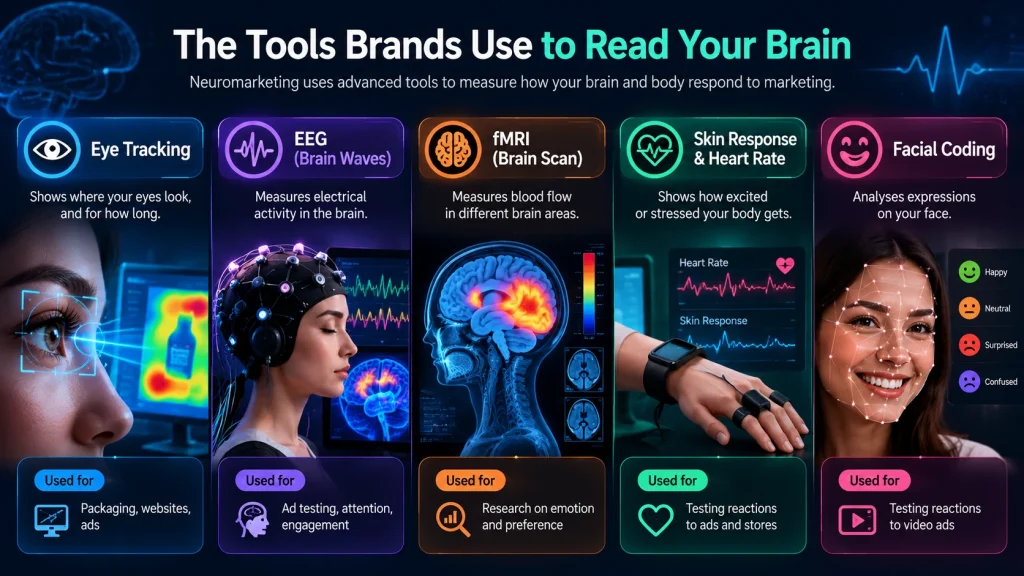
You do not need a lab coat to understand these. Here is a quick guide.
|
Tool |
What it measures |
Where it is used |
|
Eye tracking |
Where your eyes look, and for how long |
Packaging, websites, ads |
|
EEG (brain waves) |
Electrical activity in the brain |
Ad testing, attention, engagement |
|
fMRI (brain scan) |
Blood flow in different brain areas |
Research on emotion and preference |
|
Skin response and heart rate |
How excited or stressed your body gets |
Testing reactions to ads and stores |
|
Facial coding |
Expressions on your face |
Testing reactions to video ads |
Most of this happens in research labs. Volunteers sit in front of a screen, wear a headset
or a sensor, and watch an ad or look at a product. Then the data shows which parts worked.
3. What Brands Learn From Your Brain
3.1. Where Your Eyes Really Go
Eye tracking is the most common tool. It shows which part of a package, a web page, or an ad gets looked at first. It also shows what gets ignored.
A brand may think its logo is the star. The data may show people stare at the product photo instead. So the design changes.
3.2. How You Respond to Price
Ever noticed how many prices end in 9? A price of ₹499 feels smaller than ₹500, even though the gap is just one rupee. Researchers call this the left-digit effect. Our
brain reads the first number and judges the price from that.
It is a tiny trick. But across millions of sales, tiny tricks add up.
3.3. Why Some Ads Stick
Ads that tell a story and make you feel something are often remembered longer than ads that only list facts. Neuromarketing tests help brands find the exact moment in
a video where attention drops, or where emotion peaks.
3.4. Why You Love a Brand (Not Just a Product)
Here is a famous example. In a well-known 2004 brain-scan study, people tasted two cola drinks. When they did not know the brand, their choices were fairly even. When
they knew which was which, the brand name changed their brain activity and their preference.
The lesson is simple. We do not only taste the drink. We taste the story, the logo, and the memories around it.
3.5. How a Store Makes You Feel
Music, lighting, scent, and layout all shape mood. A slow song may make shoppers walk slower. A warm smell may make a shop feel friendly. These effects are usually small, and they depend on the setting. But brands test them anyway.
The
Numbers Behind the Buzz
Neuromarketing
is no longer a side experiment.
- Research
and Markets values the global market at about $3.71 billion in 2026,
growing to $5.65 billion by 2030.
- Other firms use
different methods. Market
Data Forecast puts it near $1.86 billion for 2026. So estimates range
from about $1.8 billion to nearly $4 billion.
- One market report
from Polaris
Market Research says eye tracking can lift ad conversion by up to 28%.
It also says content shaped by EEG data can bring 23% more engagement than
standard A/B testing.
A word of caution on those last two numbers. They come from a market research firm, not from a single independent trial. Treat them as a sign of the trend, not as a guarantee.
4. Can Brands Really Read Your Mind? Not Quite
Here is where we need to be honest. Neuromarketing is powerful, but it is also oversold.
According to Deep Marketing’s 2026 review, some methods have solid scientific support. These include well-run EEG and fMRI studies, and eye tracking for packaging and web design.
Other claims are mostly hype. These include reading a person’s exact emotions from their face, building secret “brain profiles” of shoppers, and using hidden messages at large scale.
So no, a brand cannot see your thoughts. What it can do is spot patterns in groups of people. That is still useful. But it is far from mind reading.
5. The Ethics Question: Where Does Persuasion End?
Good marketing has always tried to persuade. A bright poster, a catchy jingle, a “limited time” tag. None of that is new. Neuromarketing raises a sharper question. If a brand knows how your brain reacts, is it still fair persuasion? Or does it start to feel like pressure?
Most studies today use volunteers who agree to take part. That is a good start. The bigger worry is the future. As sensors move into phones, watches, and cameras, more of our body signals could become data. And as we explored in Personal Data: The New Currency of the Digital Age, data tends to get valuable fast.
Strong consent, clear rules, and honest brands will matter more every year.
6. What This Means for You: 6 Simple Habits
You do not need to fear neuromarketing. You just need to shop with open eyes.
- Pause before you buy. Wait 24 hours for non-essential items. Real wants survive the wait. Impulse wants often fade.
- Look past the price ending. Round ₹499 up to ₹500 in your head. Does it still feel like a good deal?
- Notice the mood triggers. Countdown timers, soft music, and “only 2 left” signs are built to speed you up. Slow down.
- Do not decide while tired or hungry. A calm mind makes cleaner choices.
- Cut the noise. Constant ads and alerts keep you in reaction mode. A little digital detox can sharpen your judgement.
Check app permissions. Camera, microphone, and location access can reveal more about you than you think.
7. What This Means for Students and Marketers
If you study marketing, neuromarketing is worth learning. It mixes psychology, data, and design. And it is growing alongside AI tools, which can now help analyse attention and emotion at speed. We touched on this human-versus-machine balance inAI vs Human Creativity: Who Wins?.
For your career, a few things help:
- Learn basic consumer psychology and research methods
- Get comfortable with data and simple statistics
- Study ethics, because trust is now a brand asset
- Practise telling emotional stories with clear facts
These are exactly the kind of mixed skills we covered in Skills for 2030: Preparing Students for Future Careers.
8. Quick FAQ
i. What is neuromarketing in simple words? It is the use of brain and body measurements to understand how people react to ads, products, and prices.
ii. Does neuromarketing really work? Some parts do, especially eye tracking and well-designed EEG studies. Other claims are exaggerated, so results depend on the method.
iii. Can a brand read my thoughts? No. Brands look at patterns across groups of people. They cannot see your private thoughts.
iv. Is neuromarketing manipulation? It depends on how it is used. Testing which ad is clearer is fair. Hiding how data is used, or pushing people when they are vulnerable, is not.
9. Conclusion
Neuromarketing is not magic, and it is not mind control. It is a set of tools that helps brands see what grabs your attention, what moves you, and what you remember.
Used well, it can make ads clearer, packaging simpler, and websites easier to use. Used badly, it can nudge people into choices they would not make on a calm day.
The best defence is simple awareness. The next time something feels like a perfect buy, pause. Ask yourself one question: Is this me deciding, or is it the design?
Once you start asking, you will never look at a shelf, a price tag, or an ad quite the same way again.
Resources
- Research and Markets: Neuromarketing Global Market Report 2026
- Market Data Forecast: Neuromarketing Market Size, Growth, Share & Analysis, 2034
- Polaris Market Research: Neuromarketing Market Size, Share, Growth Report & Forecast 2026–2034
- Deep Marketing: Neuromarketing Worth $3.8B in 2026: What Works, What’s Hype
Note: Market size estimates differ widely between research firms because each defines “neuromarketing” differently. Performance claims such as the 28% and 23% lifts are reported by a market research firm and should be treated as indicative. The 2004 cola brain-scan study is described in general terms from well-known published research.
Pingback: Neuromarketing Tools Explained: EEG, fMRI, Eye Tracking, and Facial Coding Compared - e-Prabandhan Gurue-Prabandhan Guru
Pingback: Neuromarketing and Indian Consumers Understanding Behavior - e-Prabandhan Gurue-Prabandhan Guru