
EEG, fMRI, eye tracking, or facial coding? Compare how each neuromarketing tool works, what it costs, and where it falls short, in plain English.
1. Introduction
Here is a puzzle. Two ads look equally good on paper. Both get great scores in a survey. But one makes people buy, and the other does nothing.
Why? The answer may be hiding in places a survey cannot reach. Where did people look? How did their brain react? Did their body get excited, or did it shrug?
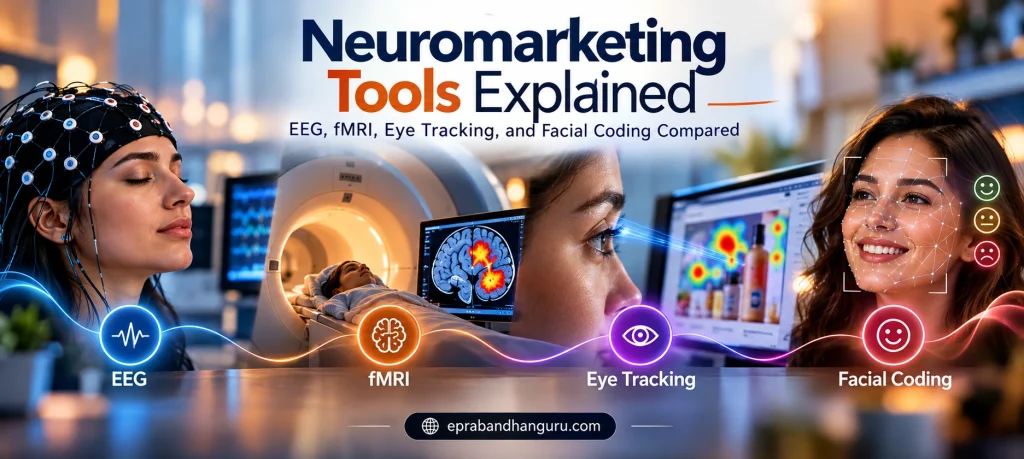
To find out, brands use special neuromarketing tools. There are four big names you will hear again and again: EEG, fMRI, eye tracking, and facial coding. They sound alike, but they do very different jobs. And one of them is a lot less reliable than its sales pitch suggests.
In this guide, we compare all four in plain English. If you want the big picture first, start with our post on how brands read your brain. Then come back here for the tools.
2. Quick Answer: The Four Tools at a Glance
| Tool | What it reads | Cost level | Best for | Biggest weakness |
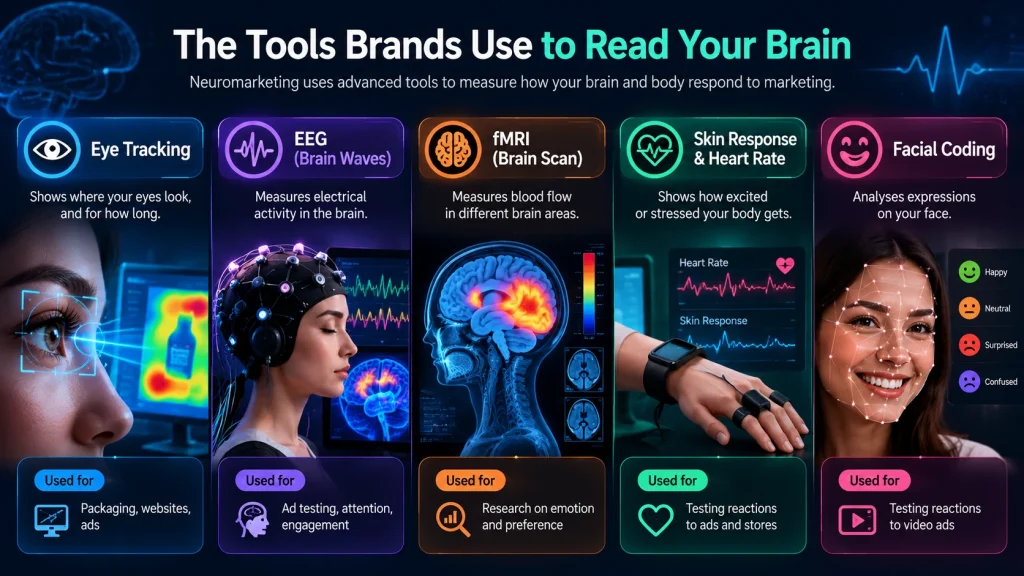
| EEG | Brain waves (electrical signals) | Medium | Video ads, attention, engagement | Hard to interpret |
| fMRI | Blood flow in the brain | Very high | Deep research on emotion and choice | Costly and not portable |
| Eye tracking | Where you look, and for how long | Low to medium | Packaging, websites, shelves | Cannot tell why you look |
| Facial coding | Muscle movements in your face | Medium | Extra data on video reactions | Weak science behind emotion claims |
Keep this table in mind. Now let’s open each tool and see how it really works.
2.1. EEG: The Stadium Microphone
2.1.1. How it works
EEG stands for electroencephalography. A headset with small sensors sits on your scalp. It picks up tiny electrical signals your brain makes all the time.
Think of a microphone hanging above a football stadium. It cannot tell you who is cheering. But it can tell you the exact moment the crowd roars. EEG works the same way. It does not show where in the brain something happens. It shows when.
2.1.2. What Brands Learn
Because EEG is so fast, it can track changes second by second. A brand can watch a video ad and see the moment attention rises, drops, or fades. That helps editors cut boring parts and keep the strong ones.
2.1.3. Cost and Limits
EEG is cheaper and more portable than a brain scanner. One research review found that devices range from about $99 for simple headsets to over $25,000 for lab-grade ones. (That review is a few years old, so prices today may differ.)
The catch? The signals are messy. NMSBA, an industry group, notes that EEG results can be hard to read and often need expert skills to run and understand. Muscle movement and even blinking can add noise.
Best for: testing video ads and
tracking attention over time.
2.2. fMRI: The Brain Heat Map
2.2.1. How It Works
fMRI stands for functional magnetic resonance imaging. You lie still inside a large scanner. It tracks changes in blood flow in the brain. When a brain area works harder, it uses more blood. The scanner spots that.
Think of a heat map on a weather app. The hot spots show where the action is. fMRI is great at showing where in the brain something happens. It is not so good at showing when, because blood flow is slow to change.
2.2.2. What Brands Learn
fMRI can show which brain areas light up when you look at a logo, taste a drink, or see a price. This makes it a strong tool for deep research. For example, the well-known cola brain-scan study we mentioned in our earlier post used this kind of imaging.
2.2.3. Cost and Limits
This is the big one. A research review estimates an fMRI machine can cost between $500,000 and $3 million. Even a single study session can cost several thousand euros, according to Donutz Digital.
You also have to lie still in a tube, which is a strange place to watch an ad. So fMRI is mostly used by universities and very large brands.
Best for: deep, academic-style research on emotion and decision making.
2.3. Eye Tracking: The Most Trusted Tool
2.3.1. How It Works
Eye tracking is simple to explain. Tiny cameras, often with infrared light, follow where your eyes move. They record what you look at first, what you skip, and how long you stare.
Think of it as following a finger across a page. Wherever your eyes go, your attention goes with them.
2.3.2. What Brands Learn
This is gold for design. A brand can see if shoppers notice the price tag. A website team can see if visitors find the “Buy” button. A package designer can see which side of the box wins the glance.
According to Deep Marketing’s 2026 review, eye tracking is the most proven neuromarketing tool for web design, packaging, and shelf placement.
2.3.3. Cost and Limits
Eye tracking is fairly affordable. The same review says a study with 30 to 50 real participants may cost roughly €5,000 to €15,000. Newer AI tools that predict where people will look start at about €500 to €2,000 a month. Webcam-based tracking is cheaper still, but it is less precise.
Here is the big limit. Eye tracking tells you where people look. It cannot tell you why. Someone may stare at a label because they love it, or because they are confused by it.
Best for: packaging, shelf layout, websites, and app design.
2.4. Facial Coding: The Tool to Be Careful With
2.4.1. How It Works
Facial coding uses software to watch your face while you view an ad. It tracks small movements in your facial muscles, like a raised brow or a lifted lip corner. Then it guesses which emotion you feel.
It sounds clever. And it is easy to set up, since a normal camera is enough.
2.4.2. The Problem
Here is the uncomfortable truth. A face does not always show what a person feels. You may smile to be polite. You may frown when you are just thinking hard. The same expression can mean different things in different people and different cultures.
Psychologist Lisa Feldman Barrett led a major 2019 review of this idea. It argued that you cannot reliably read a person’s emotion from their face alone. Deep Marketing’s guide agrees, and says selling facial coding as an objective emotion reader is scientifically wrong.
2.4.3. So Is It Useless?
Not quite. Facial coding can be a helper. If a viewer’s face shows a big reaction at the same moment their eyes or brain signals jump, that adds a clue. But it should never be the only proof.
Best for: extra data alongside other tools. Not as a stand-alone “emotion detector.”
2.5. A Bonus Tool: Skin Response (GSR)
You may also hear about GSR, or galvanic skin response. It measures tiny changes in sweat on your skin. It shows how excited or stressed you are.
The limit is clear, though. It shows the size of the reaction, not whether it was good or bad. A thrilling ad and a scary ad can look alike. So experts almost always pair GSR with other tools.
3. Head-to-Head: Which Tool Wins?
There is no single winner. Each tool answers a different question.
- “Where do people look?” Use eye tracking.
- “When does attention rise or fall?” Use EEG.
- “Which part of the brain reacts?” Use fMRI.
- “Is there an extra clue in the face?” Use facial coding, with care.
A good way to think about it is this. EEG is fast but blurry about location. fMRI is sharp about location but slow. Eye tracking shows attention but not feeling. Facial coding shows expression but not truth.
Every tool has a blind spot. That is why the smartest teams mix them.
4. Why Mixing Tools Works Better
A large review of EEG studies found something helpful. Predictions about what consumers prefer got better when EEG data was combined with other body measures, such as eye tracking or skin response.
It makes sense. One tool gives you a clue. Two or three tools give you a story.
There is a small warning, too. The same review notes that computer models can “overfit.” This means they look brilliant on the data they trained on, but fail on new people. So results should always be tested again.
5. How to Choose the Right Tool
Ask yourself three simple questions.
i. What do I want to know? Attention, emotion, or brain area?
ii. What is my budget? fMRI is for big budgets. Eye tracking and EEG suit smaller ones.
iii. What am I testing? A package or website suits eye tracking. A video ad suits EEG.
Small businesses and student projects usually do best with eye tracking, or with basic EEG and survey follow-ups. For most everyday questions, you do not need a brain scanner.
6. What This Means for Students
If you are studying marketing, psychology, or design, these tools can shape your career. Many firms need people who can read this kind of data and explain it in simple words.
A few tips to get started:
- Learn basic statistics, since every study ends in numbers
- Practise explaining a result in plain language
- Study the ethics, because trust matters as much as data
This mix of data skills and people skills is exactly what we covered in Skills for 2030: Preparing Students for Future Careers. And since AI now helps analyse eye and brain data, our post on AI vs Human Creativity is a good next read.
7. The Privacy Question
All these tools collect body data. In a lab, volunteers agree to it. But as cameras and sensors spread into daily life, the line may blur.
That is why consent and clear rules matter so much. We dig into this idea in Personal Data: The New Currency of the Digital Age.
8. Quick FAQ
What is the most accurate neuromarketing tool?
There is no single most accurate tool. Eye tracking is the best proven for design and packaging, while EEG and fMRI answer deeper brain questions.
Which neuromarketing tool is cheapest?
Eye tracking and basic EEG are the most affordable. fMRI is by far the most expensive.
Is facial coding reliable?
It is the weakest of the four for reading emotion. It works best as a supporting clue, not as proof.
Can small businesses use neuromarketing tools?
Yes. Webcam eye tracking, AI attention prediction, and simple EEG tests are within reach for many small teams.
9. Conclusion
Neuromarketing tools are not magic windows into your mind. They are more like different lenses. Each one shows a small part of the picture.
EEG shows timing. fMRI shows location. Eye tracking shows attention. Facial coding adds a hint, but only a hint.
The real skill is knowing which lens to use, and when to trust it. Next time you see a perfectly placed button or a pack that grabs your eye, you will know there may be a quiet experiment behind it.
So here is a question to take with you. If a brand could watch only one of your reactions, which one would tell the truest story?
Sources
- NMSBA: Neuromarketing Technologies Explained
- Deep Marketing: Neuromarketing Worth $3.8B in 2026: What Works, What’s Hype
- Donutz Digital: Neuromarketing: Eye-Tracking, fMRI, EEG and GSR Explained
- PubMed Central: Technological advancements and opportunities in Neuromarketing: a systematic review
- PubMed Central: A systematic review of the prediction of consumer preference using EEG measures and machine-learning in neuromarketing research
- Emotiv: Consumer Neuroscience Tools: A Beginner’s Guide
- Bitbrain: The 7 best neuromarketing techniques and tools
Note: Equipment and study prices change often and vary by country and vendor. The EEG and fMRI device prices come from a 2022 research review, and the study-cost ranges come from European agency guides, so treat all figures as rough guides. The facial coding critique refers to a widely cited 2019 review by Lisa Feldman Barrett.
Pingback: Neuromarketing and Indian Consumers Understanding Behavior - e-Prabandhan Gurue-Prabandhan Guru
Pingback: Buy with Emotion: Understanding Buying Decisions - e-Prabandhan Guru Why We Buy with Emotions and Justify with Logice-Prabandhan Guru